In the grand narrative of human construction, from the towering skyscrapers that define our city skylines to the intricate smartphones in our pockets, we often celebrate the grand visions of architects and the brilliance of engineers. Yet, there is a silent, ubiquitous workhorse that makes all of this possible: the fastener. So, what exactly is a fastener? Fundamentally, a fastener is a mechanical hardware device that joins or affixes two or more objects. They are the threads that hold the fabric of our built world intact, creating non-permanent joints that can withstand tremendous forces, yet, in many cases, can also be removed without destroying the components they unite.
While we often take them for granted, fasteners are a testament to the principle that strength lies in the details. Without these seemingly simple components, every machine, vehicle, bridge, and piece of furniture would simply collapse into a pile of disconnected parts. They are the guardians of structural integrity, the invisible bonds of modern life.
The Two Great Pillars: Permanent vs. Non-Permanent
To understand fasteners, one must first grasp their primary classification: permanent and non-permanent (or removable). Permanent fasteners, as the name suggests, are designed to create a joint that cannot be separated without damaging the components. The most common example is the rivet. Used extensively in aircraft construction, shipbuilding, and structural steelwork, rivets are deformed on one end to create a solid, permanent bulge. To remove a rivet, you must drill it out, leaving a hole behind. Similarly, welding is a form of permanent joining, though it fuses materials at a molecular level rather than using a discrete device. Permanent fasteners are chosen for their reliability and resistance to vibration, as they cannot loosen over time.
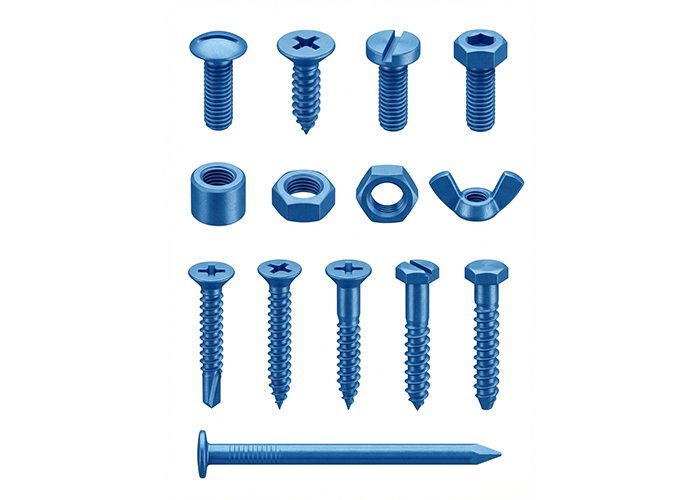
On the other hand, non-permanent fasteners are designed for assembly, disassembly, and reassembly. This category is dominated by the king of all fasteners: the threaded fastener. This family includes bolts, screws, and studs, all of which utilize the ingenious mechanical principle of the screw thread—an inclined plane wrapped around a cylinder. The most ubiquitous of all is the bolt, a threaded fastener designed to be used with a nut, and the screw, which forms or mates with internal threads within one of the materials being joined. The ability to tighten and loosen these fasteners as needed makes them indispensable for maintenance, repair, and adjustability.
A Walk Through the Fastener Family Tree
The world of fasteners is incredibly diverse, with each type engineered for a specific task. Beyond the basic bolt and screw, the family tree includes:
- Nuts: The internal-threaded partner to the external-threaded bolt. From simple hex nuts to locking nylon-insert nuts, they provide the clamping force.
- Washers: These unassuming discs are critical for load distribution, vibration damping, and preventing leaks. A flat washer spreads the load over a wider area, while a lock washer uses spring tension or sharp edges to prevent a nut from backing off.
- Anchors: For fastening into brittle materials like concrete or drywall, anchors are essential. They expand within the hole, creating a friction grip strong enough to hold heavy objects.
- Pins and Retaining Rings: These specialized fasteners don’t use threads. Dowel pins provide precise alignment, while cotter pins and snap rings (retaining rings) prevent components from sliding laterally off a shaft.
Material Science: The Choice of Steel, Stainless, and More
The performance of a fastener is only as good as its material. The most common material is carbon steel, valued for its high strength and low cost. However, plain steel rusts. Thus, many fasteners receive a protective coating, such as zinc plating (giving them that familiar silvery shine) or a black oxide finish. For applications where corrosion is a deadly enemy—marine hardware, outdoor structures, or food processing equipment—stainless steel is the champion. Its chromium content forms a passive oxide layer that resists rust. For specialized environments, fasteners are made from brass (decorative and corrosion-resistant), bronze (marine, non-sparking), titanium (aerospace, exceptionally strong and light), or high-strength alloys for critical bolting in oil refineries and power plants.
The Universal Language: Standards and Grades
A 10-millimeter bolt from Germany will fit a nut made in Japan because of standardization. The most common standards are metric (ISO) and imperial (ANI/ASME – inches). Within these standards lie grades of strength. A low-grade hardware store bolt might be Grade 2 or 4.6, suitable for a birdhouse. A high-strength bolt for a bridge or a pressure vessel, however, would be Grade 8 or 10.9, capable of withstanding immense tension. These grades are often marked on the bolt head, and misusing a low-grade bolt in a high-stress application is a recipe for catastrophic failure.
Why Fasteners Matter
In conclusion, fasteners are not just “screws and bolts”; they are the embodiment of mechanical joining. They are engineered devices that have been refined over centuries, from the crude wooden pegs of ancient ships to the precision-machined titanium screws of a jet engine. They follow the laws of physics, utilizing friction, tension, and material strength to create order from disparate parts. Next time you tighten a screw on a cabinet door or cross a steel bridge, take a moment to appreciate the fastener. It is the quiet, humble, and utterly essential hero that holds our modern world together, one thread at a time.