
In the contemporary manufacturing landscape, precision is not merely a desirable attribute—it is an absolute necessity. As industries from aerospace to medical devices demand ever-tighter tolerances and increasingly complex geometries, precision turning milling components have emerged as indispensable elements of the production ecosystem. These components, produced through the integration of computer numerical control (CNC) turning and milling operations, represent the pinnacle of subtractive manufacturing technology.
Understanding Precision Turning and Milling
Precision machining is a manufacturing process that enables the production of high-quality, accurate components with desirable surface finishes and tight tolerances. The process encompasses a wide range of machining operations, but turning and milling stand as the two fundamental pillars. During CNC turning, the workpiece is driven in rotation by the spindle, and a non-rotating cutting tool machines material off the outside or inside diameter. This configuration makes turning ideally suited for cylindrical or rotationally symmetrical parts such as shafts, bushings, and pulleys, delivering superior concentric control.
CNC milling, by contrast, involves a rotating cutting tool that moves through multiple axes around a stationary workpiece. This approach excels at producing flat surfaces, complex contours, cavities, and intricate three-dimensional geometries. While turning creates roundness with exceptional precision, milling offers unparalleled geometric flexibility for multi-surface components.
The Turn-Mill Revolution
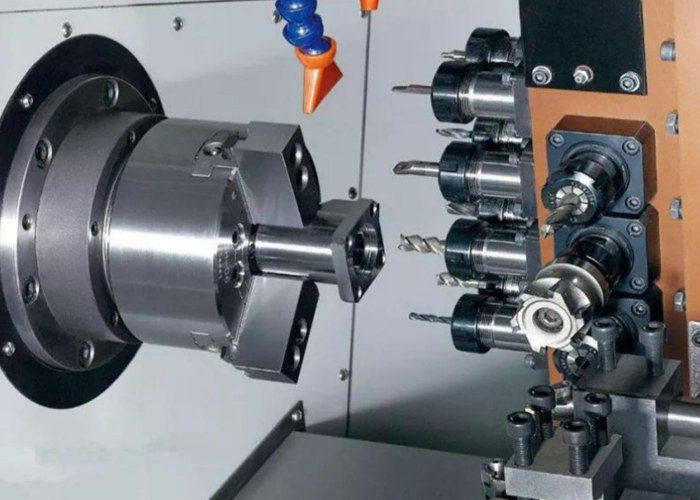
The true transformative power in modern manufacturing lies not in turning or milling alone, but in their integration. A CNC turning and milling center—also called a turn-mill center—combines both operations in a single setup. These multitasking machines eliminate secondary operations, reduce errors from manual transfers, and increase overall part accuracy. By merging the symmetry control of a turning machine with the geometric freedom of a milling machine, a part that once required multiple setups across different departments can now be completed in one coordinated cycle.
The technical capabilities of modern turn-mill centers are remarkable. Featuring live tooling and synchronized Y/C-axis interpolation, these machines enable comprehensive multi-tasking machining—including turning, milling, drilling, tapping, and boring—all within a single workholding. Advanced models feature twin spindles with synchronized part transfer, enabling complete front-and-back operations in one cycle. Some systems achieve machining errors as tight as ±3 μm in turning and ±7 μm in milling, while repeatability can reach ±0.005 mm.
Key Advantages of Precision Turn-Mill Components
The advantages of precision turning milling components extend far beyond mere convenience. First and foremost is the dramatic reduction in setup time and fixturing requirements. When a component can be machined in a single setup, the cumulative tolerance stack-up that results from multiple re-clampings is eliminated. This directly translates to improved dimensional accuracy and feature relationship consistency.
Productivity gains are equally significant. Turn-mill centers enable complete machining in one setup, delivering shorter cycle times and reduced setup costs. Cycle time reductions of up to 40% are achievable in high-mix production environments. Furthermore, by eliminating the need to transfer parts between machines, manufacturers avoid the errors and delays inherent in manual handling.
Surface finish and dimensional precision also benefit substantially from integrated machining. With post-process grinding and honing, accuracies in the micrometre range and surface quality up to Ra 0.01 can be achieved. Standard CNC turning can maintain tolerances around ±0.002 mm on cylindrical features, while milling achieves precision within a few microns.
Materials and Applications
Precision turning milling components are manufactured from a diverse range of materials, including aluminum alloys (6061-T6, 7075-T6), stainless steel (300- and 400-series), alloy steel, copper alloys, and titanium. The choice of material depends on the application requirements for strength, corrosion resistance, weight, and thermal stability.
The applications of these components span virtually every advanced industry sector. In aerospace, precision turn-mill parts are essential for engine components, hydraulic fittings, and structural elements where failure is not an option. The medical industry relies on these components for surgical instruments, implants, and diagnostic equipment, where micron-level accuracy can be a matter of life and death. Automotive applications range from powertrain components to fuel injection systems, with electric vehicle drivetrains creating new demands for high-speed, lightweight precision parts.
Other critical sectors include industrial automation, electronics, robotics, defense, telecommunications, and oil and gas. The versatility of precision turning milling components is further evidenced by their use in gears, shafts, spindles, connectors, housings, valves, and optical equipment.
Future Trends and Industry Outlook
The precision turned product manufacturing market is experiencing robust growth, projected to reach USD 142.66 billion by 2031 at a CAGR of 5.39%. Several key trends are shaping this expansion. The rise of smart manufacturing and the adoption of Industry 4.0 technologies are enhancing operational efficiency, reducing waste, and improving product quality. Automation, digitalization, and the integration of advanced materials are becoming standard practice.
Multi-axis CNC adoption is accelerating, with modern turning centers capable of simultaneous multi-axis operation finishing complex components in a single setup. The integration of digital twins, predictive analytics, and adaptive CAM software that adjusts feeds and speeds in real-time is achieving significant cycle time reductions for difficult-to-machine materials like Inconel 718 and Ti-6Al-4V.
The demand for electric vehicle components is driving innovation in lightweight precision parts, while the aerospace sector’s build-rate surge and maintenance, repair, and overhaul (MRO) requirements continue to push the boundaries of what is possible in precision machining. As expectations for durability, material performance, and geometric accuracy intensify, precision turning milling components will remain at the forefront of manufacturing technology.
Conclusion
Precision turning milling components represent the convergence of advanced machinery, sophisticated software, and skilled craftsmanship. From the tiny screws that power Swiss watches to the critical components that keep aircraft aloft, these parts are the unsung heroes of modern industry. As manufacturing continues to evolve toward greater automation, integration, and intelligence, the role of precision turn-mill technology will only grow in importance, enabling the production of ever more complex, reliable, and high-performance components for the challenges of tomorrow.


