
In the grand narrative of industrial advancement, we often celebrate the final product: the sleek smartphone, the powerful jet engine, or the life-saving medical implant. However, beneath the surface of these marvels lies a critical, often invisible, foundation: Precision Processing Service. It is the silent architect of the modern world, a discipline that transforms raw materials and rough ideas into components with tolerances measured in microns.
At its core, Precision Processing Service is not merely about cutting, shaping, or finishing materials. It is the art and science of adding value through absolute control. In an era defined by miniaturization and complexity, the ability to manipulate matter with exacting accuracy has shifted from a competitive advantage to a fundamental requirement. This article delves into the essence of this specialized field, exploring its key facets, technological drivers, and its profound impact on the global supply chain.
Beyond Machining: The Holistic Service Ecosystem
To understand Precision Processing, one must move beyond the image of a standalone CNC machine humming in a factory. A true Precision Processing Service is a holistic ecosystem. It begins long before the first chip is cut. It starts with engineering collaboration. Clients often approach service providers with a concept or a performance requirement, not just a blueprint. The processor acts as a partner, analyzing the design for manufacturability (DFM), suggesting material optimizations, and identifying potential failure points that could compromise the integrity of the final part.
This service layer includes rigorous material sourcing. Different alloys, polymers, and composites react differently to processing. A high-quality service provider possesses the metallurgical knowledge to select the right stock, ensuring that the internal grain structure and material properties align perfectly with the intended application—whether it’s a titanium bone screw requiring biocompatibility or an aerospace component demanding high-temperature resistance.
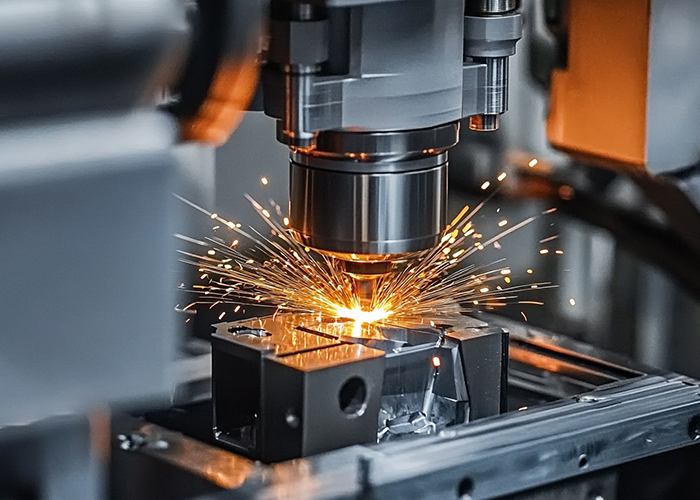
The “processing” itself is a symphony of advanced techniques. While CNC machining (milling, turning, grinding) remains the backbone, modern precision services integrate Electrical Discharge Machining (EDM) for intricate cavities, laser cutting for complex geometries in sheet metal, and for achieving the required surface integrity, advanced surface finishing techniques like electropolishing and abrasive flow machining are utilized. The goal is not just dimensional accuracy, but functional perfection.
The Language of Microns: Tolerance and Quality Assurance
The currency of this industry is the micron. In high-stakes sectors like aerospace, defense, and semiconductor manufacturing, a deviation of a few microns—less than the width of a human hair—can render a component useless or, worse, dangerous. Precision Processing Services, therefore, are defined by their metrology capabilities.
A state-of-the-art service provider invests heavily in inspection technology. Coordinate Measuring Machines (CMMs), both bridge and portable, optical comparators, and white light scanners are used to verify every critical dimension. This is not a cursory check; it is a data-driven validation process. The rise of Industry 4.0 has led to the integration of in-process monitoring, where sensors on the machine tool provide real-time feedback, allowing for adaptive control and ensuring that quality is built into the part, not just inspected at the end.
For the client, outsourcing to a specialized precision processor is a risk mitigation strategy. By partnering with a certified provider (such as those holding AS9100 for aerospace or ISO 13485 for medical devices), manufacturers can offload the immense cost of maintaining cutting-edge equipment and highly skilled metrology teams, instead receiving a component that is guaranteed to perform.
Enabling Innovation: The Industries Served
Precision Processing Services are the enablers of technological breakthroughs. Consider the medical device industry. The production of stents, orthopedic implants, and surgical instruments requires geometries that are impossible to achieve with standard manufacturing. Precision processors utilize laser micro-machining and Swiss-type screw machining to create the micro-scale, burr-free features essential for these life-saving devices.
In the world of optics and photonics, precision processing is used to create housings for lenses and sensors that demand near-perfect alignment. The telecommunications industry relies on it for the intricate connectors and waveguides that form the backbone of the internet. Even the energy sector, in its quest for more efficient gas turbines, relies on precision processors to create cooling holes in turbine blades—holes angled so precisely that they dictate the thermodynamic efficiency of an entire power plant.
The Future: Automation, AI, and the Human Element
As we look to the future, the field of Precision Processing Service is on the cusp of another revolution. Automation is moving beyond simple part loading. We are seeing the rise of “lights-out” manufacturing, where robotic cells tend to machines for hours without human intervention, guided by sophisticated software.
Artificial Intelligence (AI) is beginning to play a role in predictive maintenance and tool wear optimization. By analyzing the data streams from machine tools, AI algorithms can predict when a cutting tool is about to fail and automatically adjust parameters or schedule a change, preventing costly scrap.
However, despite the march of technology, the human element remains irreplaceable. The most sophisticated machine is still guided by the expertise of a skilled process engineer. It is their understanding of material science, cutting dynamics, and thermal effects that translates a digital model into a physical reality. The precision processing service of the future will be a hybrid model, leveraging the brute force and consistency of machines with the ingenuity and problem-solving capabilities of people.
Conclusion
In conclusion, Precision Processing Service is far more than a manufacturing step; it is a critical pillar of industrial innovation. It is the bridge between concept and reality, turning fragile designs into durable, high-performance components. As products continue to shrink in size and grow in complexity, the demand for this silent, precise art will only intensify. The companies that master this discipline will not just be suppliers; they will be indispensable partners in building the future.


