
In an age dominated by digital interfaces, artificial intelligence, and software-driven solutions, it is easy to overlook the tangible, physical foundation upon which all this technology rests. Before the algorithm processes the data, and before the electric current lights the screen, there is the machine. And at the heart of every machine, from a life-support ventilator to a reusable rocket, lies the humble yet miraculous reality of Precision Mechanical Parts.
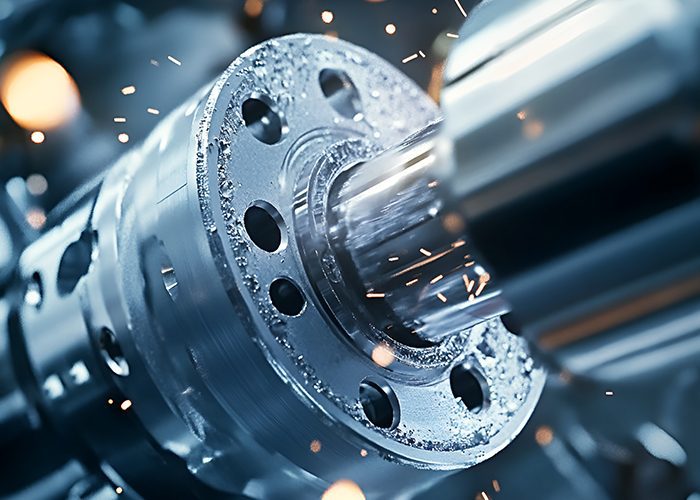
Precision mechanical parts are defined by a deceptively simple metric: tolerance. While standard manufacturing might accept a variation of a few millimeters, precision machining operates in the realm of microns—thousandths of a millimeter. To put this into perspective, a human hair is approximately 70 microns thick. A truly precision part might have tolerances of 1 or 2 microns, or even sub-micron levels. We are talking about the difference between a “loose fit” and a “sealed connection” that can withstand 10,000 atmospheres of pressure.
The Art and Science of Manufacturing
Creating these parts is not merely “cutting metal”; it is a sophisticated symphony of physics, material science, and computer programming. The primary workhorses of this industry are CNC (Computer Numerical Control) machines. These include milling machines that carve out complex 3D shapes, lathes that spin the material to create perfect cylinders, and Electrical Discharge Machines (EDM) that use precise electrical sparks to erode conductive materials into shapes that traditional blades cannot reach.
However, the machine is only half the equation. The “part program”—the set of G-code instructions driving the machine—is the brain. A programmer must dictate not just where the tool goes, but how fast it spins (surface speed), how aggressively it cuts (feed rate), and how deep it penetrates (depth of cut). One wrong decimal point in the code, or a vibration as thin as a piece of paper, can scrap a part that took four hours to rough-cut.
The “Why” Behind the Precision
One might ask: Why is this level of accuracy necessary? Does a door hinge need to be accurate to a micron? No. But a fuel injector nozzle in a diesel engine does. The answers lie in four critical areas:
- Performance and Efficiency: In the aerospace industry, a turbine blade that is a few microns off-spec will disrupt airflow. This disruption creates drag and inefficiency, leading to higher fuel burn. On a transatlantic flight, that microscopic error could translate into thousands of dollars of wasted fuel. In hydraulics, precision fit prevents internal leaks, ensuring that every drop of fluid moves the piston rather than slipping past it.
- Interchangeability and Assembly: The modern global economy relies on the “lego block” theory of manufacturing. A gearbox casing made in Germany must accept a bearing made in Japan, which must fit a shaft made in Mexico. Without standardized, precise dimensions, “mass production” would devolve into “individual hand-fitting.” Precision allows for the miracle of the assembly line, where millions of identical parts come together seamlessly without modification.
- Reducing Friction and Wear: Rough surfaces grind against each other. Precision surfaces slide. In high-speed applications, reducing friction is the difference between a bearing that lasts 10 years and one that seizes in 10 minutes. Polished, exact surfaces distribute loads evenly, drastically reducing the localized heat that causes fatigue and failure.
- Innovation Enablement: Moore’s Law applies to chips, but a similar law applies to mechanical devices. Medical devices like robotic surgery tools require gears and linkages with near-zero backlash (play) so that when a surgeon moves a joystick 0.1mm, the scalpel inside the patient’s eye moves exactly 0.1mm—not 0.11mm.
The Challenges of the Trade
Working at this level of detail is unforgiving. Temperature is the silent enemy. A 10-degree Celsius rise in a shop floor can cause a 100mm steel part to grow by over 10 microns, potentially pushing it out of spec. Machinists often work in climate-controlled “clean rooms” wearing gloves and gowns, more akin to a semiconductor fab than a traditional workshop.
Furthermore, the tools themselves wear out. A carbide end mill may start with a perfect cutting edge, but after 200 inches of cutting hardened steel, it loses a micron of its edge. If the machine doesn’t detect that wear, the next part will be a reject.
Applications Across Industries
The silent work of precision machining is everywhere. In medicine, it is the bone screws and spinal rods that require a specific surface finish to encourage osseointegration (bone growth). In automotive, it is the common rail system that injects diesel at 2,000 bar of pressure. In defense, it is the guidance system gimbals that keep a missile on course through 50g turns. In consumer electronics, it is the camera actuator that moves the lens microns at a time to focus your smartphone photo instantly.
The Future is Hybrid
As we look forward, precision mechanical parts are not being replaced by digital technology; they are being enhanced by it. We are entering the age of “cyber-physical systems.” Smart factories use laser sensors to measure a part while it is still spinning on the machine, and the software automatically adjusts the tool path to compensate for any detected deviation. Additive manufacturing (3D printing) creates near-net shapes, which are then finished by precise subtractive machining—giving us complex internal lattices that are geometrically impossible to produce via traditional cutting.
In conclusion, precision mechanical parts are the silent, uncelebrated backbone of the physical world. They are the evidence of human ingenuity applied to the hardest of materials. While software may glitch and electricity may surge, a well-machined stainless steel gear, cut to a tolerance of 2 microns, will turn reliably for a century. That durability is the quiet promise that keeps our modern world in motion.


