
In an age where digital intelligence and physical manufacturing converge, precision CNC machining stands as one of the most critical, yet often overlooked, pillars of industrial progress. From the titanium bone plates that mend a fractured human skeleton to the turbine blades that endure incandescent heat inside a jet engine, countless components around us owe their existence to this subtractive manufacturing marvel. CNC, short for Computer Numerical Control, represents a quantum leap from manual machining; it is the art of removing material with microscopic accuracy under the silent governance of code.
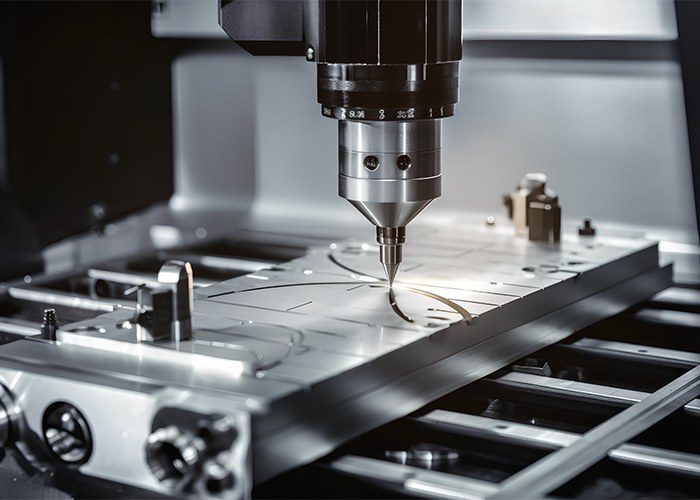
At its core, precision CNC machining transforms a solid block of material—metal, plastic, ceramic, or composite—into a finished part by cutting away excess matter. Unlike 3D printing, which builds objects layer by layer, CNC is subtractive, and its greatest virtue is discipline. A typical CNC machine, be it a milling center, lathe, or grinder, follows a set of programmed instructions (G-code) to position a cutting tool against a workpiece with tolerances often reaching ±0.005 mm, or even tighter for ultra-precision applications. To put that in perspective, such accuracy is roughly one-tenth the thickness of a human hair.
The ecosystem of precision CNC machining is diverse. Multi-axis milling machines—capable of moving tools along five or more axes simultaneously—can sculpt complex geometries that would have been impossible a generation ago. Swiss-type lathes, originally designed for watchmaking, excel at producing tiny, delicate components with exceptional length-to-diameter ratios. Electrical Discharge Machines (EDM), another branch of the CNC family, use controlled sparks to erode conductive materials, allowing for features like sharp internal corners that conventional cutters cannot reach. Together, these machines form a silent symphony of steel and carbide, orchestrated by software and monitored by laser sensors.
Why has precision CNC machining become indispensable across virtually every high-stakes industry? The answer lies in three words: accuracy, repeatability, and scalability.
In the medical field, a poorly machined hip implant—off by a few hundredths of a millimeter—could cause chronic pain, inflammation, and premature failure. Precision CNC ensures that each implant, bone screw, or surgical guide is an identical copy of the CAD model, batch after batch. Aerospace components face even more extreme demands. A cooling hole in a turbine blade, for instance, must be machined at a precise angle and diameter to prevent catastrophic meltdown at 1500°C. Here, failure is not an option, and only CNC machining can deliver the required consistency from the first part to the ten-thousandth.
The automotive industry, despite its shift toward electric vehicles, continues to rely on precision machining for motors, inverters, and braking systems. Electric motor rotors require perfectly balanced shafts, and battery housings need exact sealing surfaces to keep moisture out. Even the humble aluminum chassis of a smartphone, with its chamfered edges and precisely placed button cutouts, is the product of hundreds of CNC drilling and milling operations—often performed by armies of small “spindle farms.”
However, achieving these results is not simply a matter of pressing “start.” Precision CNC machining is an ecosystem of interrelated expertise. The process starts with CAD (Computer-Aided Design), where an engineer defines the geometry. Then CAM (Computer-Aided Manufacturing) software takes over, generating toolpaths that must account for tool deflection, material hardness, thermal expansion, and chip evacuation. A machinist must then select the appropriate cutter—carbide, coated, single-flute or multi-flute—and set workholding fixtures that can resist cutting forces without distorting the part. The machine itself might need to warm up for an hour to reach thermal stability, and coolant must be directed precisely to prevent heat warpage. Every variable matters.
The future of precision CNC machining is being shaped by three major trends: automation, hybrid manufacturing, and intelligence. Robotic arms now load and unload pallets from CNC machines, allowing “lights-out manufacturing” where factories run unattended through the night. Hybrid machines that combine CNC milling with laser metal deposition (a form of 3D printing) enable repair of expensive parts: a worn turbine blade can have new material added and then be machined back to original specifications, all on the same machine. Meanwhile, artificial intelligence is beginning to monitor vibration, spindle load, and acoustic signatures in real time, predicting tool breakage before it happens and adjusting feeds and speeds on the fly.
Yet, for all its sophistication, precision CNC machining also faces a skills challenge. The days of the old-school machinist with oily hands and mechanical instinct are not gone, but transformed. Today’s CNC machinist must read G-code, understand GD&T (Geometric Dimensioning and Tolerancing), program CAM toolpaths, and troubleshoot a 5-axis head. There is a global shortage of such hybrid talents—part engineer, part programmer, part craftsman.
In conclusion, precision CNC machining is far more than a manufacturing process. It is a discipline of exacting standards, a bridge between the virtual perfection of digital models and the stubborn realities of physical materials. As technologies like artificial intelligence and hybrid processes continue to evolve, the fundamental mission remains unchanged: to remove only what is necessary, with a fidelity that borders on the absolute. Every time you hold a product that feels solid, moves smoothly, or fits perfectly, there is a high probability that precision CNC machining had a hand in its creation—quietly, accurately, and without applause.


