
In the landscape of modern manufacturing, few processes have redefined the boundaries of precision and versatility as profoundly as Custom CNC Milling. As a subtractive manufacturing technique, it uses computer-controlled rotary cutters to remove material from a solid block—known as the workpiece—to create a custom-designed part. Unlike traditional milling, which often requires manual intervention and lacks repeatability, custom CNC milling offers unparalleled accuracy, scalability, and complexity. From a single medical implant prototype to mass-produced aerospace components, this technology has become industry’s silent workhorse.
What Exactly Is Custom CNC Milling?
At its core, CNC refers to Computer Numerical Control. A CNC milling machine translates digital 3D models (typically CAD files like STEP or IGES) into precise G-code instructions, which dictate every movement of the cutting tool. By definition, “custom” implies that every part is produced to its own specifications; each order is essentially one of a kind. This stands in contrast to standard off-the-shelf components. The milling process itself involves multi-axis movement: the workpiece may move along the X, Y, and Z axes, while advanced machines also rotate on A, B, or C axes (4‑axis, 5‑axis, or even 6‑axis milling). This allows operators to machine intricate geometries, undercuts, and complex contours in a single setup.
Common materials include metals (aluminum, stainless steel, titanium, brass), engineering plastics (ABS, PEEK, nylon), and composites. The choice of material dictates cutting speed, tool type, and cooling requirements.
The Workflow: From Concept to Finished Part
The journey of a custom CNC milled part typically follows five key steps:
- Design & CAD Modeling: An engineer creates a detailed 3D solid model using software like SolidWorks, Fusion 360, or AutoCAD. This model includes all tolerances, surface finishes, and hole callouts.
- CAM Programming: The CAD file is imported into CAM (Computer-Aided Manufacturing) software. Here, the programmer defines toolpaths—roughing passes to quickly remove bulk material, and finishing passes to achieve precise dimensions and smooth surfaces. Simulators often detect potential collisions or tool breaks before a single chip is cut.
- Machine Setup: The operator secures the workpiece to the machine bed using vises, fixtures, or vacuum chucks. Appropriate cutting tools (end mills, face mills, drills, reamers) are loaded into the spindle or tool changer.
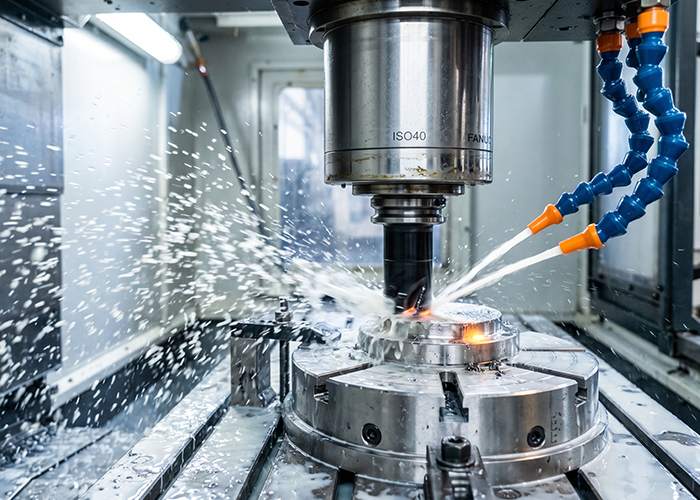
- Milling Execution: With the G-code running, the machine autonomously executes the program. High-pressure coolant washes away chips, and in-machine probes may perform in‑process inspections to correct for any thermal expansion or tool wear.
- Post‑Processing & Quality Control: After milling, parts may undergo deburring, heat treatment, anodizing, or polishing. Each part is then measured—using CMM (Coordinate Measuring Machines), optical comparators, or simple calipers—to verify it meets the design’s GD&T (Geometric Dimensioning and Tolerancing) specifications.
Key Advantages of Going Custom
Why choose custom CNC milling over 3D printing, injection molding, or manual machining? The benefits are compelling:
- Material Integrity: Because it is a subtractive process, the internal properties of the original solid stock remain unchanged. There are no layer lines (as in printing) or weld lines (as in molding), making milled parts ideal for high‑stress applications like engine mounts or surgical tools.
- High Precision & Repeatability: Modern CNC mills hold tolerances as tight as ±0.0005 inches (±0.0127 mm). For serial production, the 100th part is identical to the first, with no human fatigue.
- Complex Geometry Without Fixturing Nightmares: 5‑axis simultaneous milling can access five faces of a part in one clamping, eliminating multiple setups and improving accuracy. This is indispensable for impellers, turbine blades, and prosthetic knees.
- Low to Medium Volumes at Affordable Cost: While injection molding requires expensive molds ($10,000+), CNC milling has no tooling cost besides workholding. For quantities from 1 to 10,000 units, milling is often the most economical route.
- Rapid Iteration: Design changes that would render a hard tool obsolete can be accommodated in minutes by editing the CAM file. This accelerates R&D cycles dramatically.
Real-World Applications Across Industries
Custom CNC milling isn’t confined to any single sector—it is everywhere:
- Aerospace: Structural brackets, manifold housings, and landing gear components made from high‑grade aluminum or Inconel. These parts must withstand extreme temperatures and vibrations while being lightweight.
- Medical & Dental: Hip stems, bone plates, spinal cages, and dental abutments. Biocompatible titanium and PEEK are milled to patient‑specific geometries derived from CT scans.
- Automotive: Prototype intake manifolds, custom gearbox casings, one‑off suspension components for racing teams, and jigs for assembly lines.
- Electronics: Heat sinks, RF shielding enclosures, and connector housings. CNC milling’s ability to create thin walls and fine details is critical here.
- Defense & Firearms: Receivers, triggers, and scope mounts. The consistency and durability of milled parts meet stringent military standards (e.g., MIL‑SPEC).
- General Engineering: Any custom fixture, replacement part for legacy machinery, or tooling for injection molds—often machined from tool steel or hardened materials.
Limitations and Considerations
No process is perfect. Custom CNC milling does have drawbacks:
- Material Waste: Up to 80% of the original block can become chips, especially for complex shapes. This makes it less sustainable than additive manufacturing for net‑shape parts, though metal chips are recycled.
- Size Constraints: While gantry mills can handle parts several meters long, most job shops have machines with work envelopes around 600×400×300 mm. Larger parts require specialized equipment.
- Internal Geometry Limits: Unlike 3D printing, CNC milling cannot produce fully enclosed internal cavities or deep, narrow channels without using special tools (e.g., lollipop cutters) or EDM.
- Cost per Part for High Volumes: Above 10,000 units, injection molding or casting becomes cheaper on a per‑part basis due to faster cycle times.
The Future: Automation and Hybrid Machines
Custom CNC milling continues to evolve. Today, many shops employ automated pallet changers and robotic arms that run lights‑out production overnight. Hybrid machines that combine 5‑axis milling with laser metal deposition (additive) allow repairing damaged parts or creating near‑net shapes before finish milling. Real‑time process monitoring using vibration sensors and AI predicts tool breakage before it happens.
Furthermore, the rise of online CNC services—where you upload a CAD file and receive a price quote within hours—has democratized access. Small startups and hobbyists can now obtain professional milled parts without owning six‑figure machinery.
Conclusion
Custom CNC milling remains the gold standard for functional, high‑precision parts across almost every engineering discipline. It bridges the gap between one‑off prototypes and mass production, offering unmatched material flexibility, tight tolerances, and geometric complexity. While 3D printing and other technologies have captured headlines, the truth is that the vast majority of metal parts you see—from an aircraft turbine to a dentist’s drill—still start as a solid block that is carefully carved away under computer control. If you need a part that must be strong, accurate, and made exactly to your drawing, custom CNC milling is not just an option; it is the answer.


