In the vast ecosystem of modern manufacturing, where micron-level tolerances can mean the difference between a revolutionary product and a catastrophic failure, subtractive manufacturing processes remain indispensable. Among these, Custom CNC Turning stands out as a cornerstone technology for producing cylindrical components with exceptional speed, accuracy, and repeatability. While standard off-the-shelf turned parts serve many basic functions, the rise of highly specialized industries—from aerospace to medical devices—has cemented the demand for fully customized solutions. This article explores the intricacies, advantages, material versatility, and real-world applications of custom CNC turning.
What Exactly Is Custom CNC Turning?
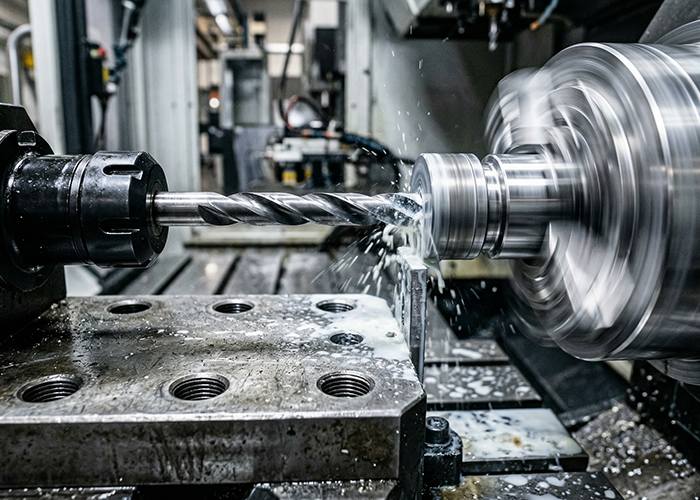
At its core, CNC (Computer Numerical Control) turning is a machining process that rotates a cylindrical workpiece at high speeds while a stationary cutting tool traverses along two or more axes to remove material. The result is a symmetrical part with precise diameters, grooves, tapers, and threads. The “custom” aspect elevates this process from generic production to bespoke engineering. Unlike mass-produced standardized components (such as screws or generic bushings), custom CNC turning involves parts designed to exact client specifications—often one-off prototypes or low-to-medium volume batches tailored for a unique assembly or function.
Every custom job begins with a detailed digital blueprint, typically a CAD (Computer-Aided Design) file. This file is converted into G-code, the language that guides the CNC lathe’s movements, spindle speed, tool selection, and coolant flow. The human element remains critical: skilled machinists select the appropriate toolpaths, work-holding strategies, and cutting parameters to achieve the desired surface finish and geometric fidelity.
Key Advantages Over Conventional Turning
Why would an engineer or product designer choose custom CNC turning over manual turning or even other CNC processes like milling? The advantages are compelling.
First, unparalleled precision is the hallmark of custom CNC work. Modern CNC lathes routinely achieve tolerances of ±0.0005 inches (±0.0127 mm) or better. For mission-critical components like valve stems or surgical bone drills, such accuracy is non-negotiable. Second, complex geometries that would be impossible or economically unviable on manual lathes become routine. Custom programming allows for eccentric turning, polygon profiling, and intricate undercuts without requiring multiple setups or special cams.
Third, scalability and consistency are vital. Once a custom program is proven and optimized, the machine can produce hundreds or thousands of identical parts with minimal deviation. This repeatability ensures that the first part is statistically identical to the ten-thousandth part. Finally, material efficiency is significantly higher than additive methods for cylindrical parts; custom turning often utilizes bar feeders and optimized toolpaths to minimize scrap, reducing raw material costs over time.
Material Universe: From Plastics to Superalloys
One of the most powerful aspects of custom CNC turning is its compatibility with an enormous range of materials. This flexibility allows engineers to select substrates based purely on functional requirements (strength, weight, corrosion resistance, thermal conductivity) rather than manufacturability.
On the metal side, common choices include aluminum (6061, 7075) for lightweight aerospace fittings; stainless steels (303, 304, 316) for medical and food-grade components requiring corrosion resistance; brass and copper for electrical connectors and decorative hardware; and titanium (Grade 5, Ti-6Al-4V) for high-performance automotive and implantable medical devices. For extreme environments, exotic alloys like Inconel, Monel, and Hastelloy are routinely turned, albeit with specialized tooling and slower feed rates due to their work-hardening tendencies.
Plastics are equally well-suited to custom turning. Delrin (acetal) is beloved for its low friction and dimensional stability, making it ideal for gears and bushings. PTFE (Teflon) provides chemical inertness, while PEEK offers high-temperature resistance for semiconductor and oil/gas applications. Even engineering ceramics (though highly challenging) can be turned with diamond tooling.
Real-World Applications Across Industries
Custom CNC turning is not an abstract technology—it quietly powers the modern world. Consider the automotive industry, where custom-turned turbocharger shafts, fuel injector nozzles, and sensor housings are critical. High-performance racing teams rely on one-off turned parts for suspension components and drivetrain prototypes.
In aerospace, safety and reliability demand custom turning for landing gear pins, hydraulic fittings, and engine mount bushings. Every gram and every micron is scrutinized; turning provides the necessary surface integrity and fatigue resistance that additive manufacturing often cannot guarantee.
The medical sector uses custom turning to produce bone screws, spinal fixation rods, dental implant abutments, and surgical shaver blades. These parts often have patient-specific geometries or require ultra-smooth finishes to prevent bacterial adhesion. Robotics and automation depend on turned shafts, precision rollers, and end-effector components tailored to fit unique actuators or linear guides.
Even consumer products benefit: think of the bespoke aluminum flashlight bodies, custom vaping device terminals, or high-end fountain pen nibs turned by small machine shops serving niche markets.
The Trade-Offs: Limitations to Consider
Despite its prowess, custom CNC turning is not a panacea. The process is inherently limited to parts with rotational symmetry. While live tooling (on a CNC turning center with a milling spindle) can add flats, cross-holes, and slots, highly complex, non-cylindrical parts are better suited to 5-axis CNC milling. Additionally, the initial setup cost—including CAD/CAM programming, tool selection, and fixturing—can be high for single-piece orders. However, for medium to large runs, the per-part cost plummets due to automated operation.
The Future: Automation and Subtractive-Additive Hybrids
The field of custom CNC turning is evolving rapidly. Swiss-type lathes, which combine sliding headstock technology with guide bushings, are now standard for producing miniature, high-precision parts (down to 0.1 mm diameter) for electronics and micro-medical devices. Automation via robotic arms and bar loaders enables “lights-out” manufacturing—running custom jobs overnight without human intervention. Finally, hybrid machines that integrate directed energy deposition (metal 3D printing) with traditional turning are emerging, allowing repair of damaged turned parts or addition of complex features onto a turned blank.
Conclusion
Custom CNC turning is far more than a legacy process; it is a dynamic, precision-driven manufacturing solution that adapts to the unique demands of each client. By offering micron-level tolerances, vast material choices, and the ability to transition seamlessly from prototype to production, it remains an irreplaceable tool in the global supply chain. Whether crafting a single titanium bone screw or ten thousand stainless steel hydraulic fittings, custom CNC turning delivers the perfect intersection of digital design and physical precision. For any engineer seeking reliability, accuracy, and geometrical freedom in cylindrical components, custom CNC turning is not just an option—it is the gold standard.