
In the ever-evolving landscape of modern manufacturing, precision is not just a requirement—it is an expectation. Among the many processes that drive industrial production, CNC turning remains one of the most fundamental and versatile methods for creating cylindrical components. However, as industries move toward greater specialization and performance-driven design, the demand for customization CNC turning parts has surged dramatically. Off-the-shelf components no longer suffice when engineers seek optimized geometries, exotic materials, or micron-level tolerances. This article explores the value, process, and applications of custom CNC turned parts in today’s engineering ecosystem.
What Is CNC Turning and Why Go Custom?
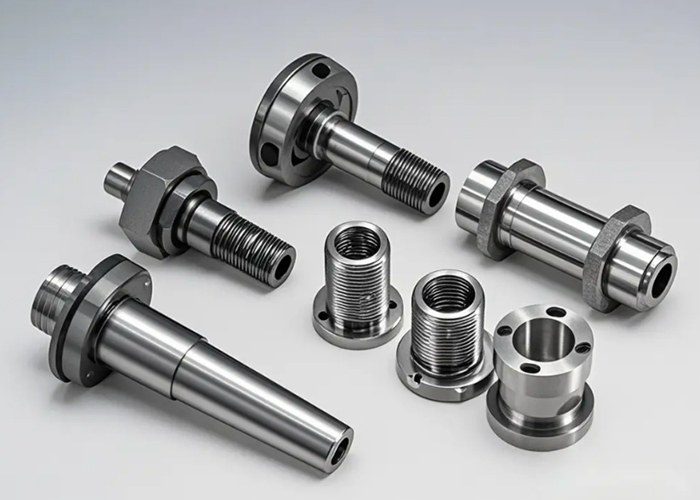
CNC turning is a subtractive manufacturing process where a cutting tool removes material from a rotating workpiece to produce symmetrical parts—ranging from simple shafts to complex threaded bushings. The “CNC” (Computer Numerical Control) aspect ensures repeatability and automation, but customization adds a strategic layer: parts are designed and machined to meet unique specifications rather than generic standards.
Customization matters because no two applications are identical. A aerospace fastener must withstand extreme temperature cycles; a medical bone screw demands biocompatibility and microscopic surface finish; an automotive transmission component requires high fatigue resistance. Standard parts may fit dimensionally but often fail in performance. Custom CNC turning allows engineers to tailor every parameter—diameter, length, internal features, threads, grooves, chamfers, and surface coatings—exactly to the functional requirements.
The Design-to-Manufacturing Workflow
Creating a custom turned part begins with a technical drawing or a 3D CAD model. Modern CNC turning centers can read CAM data directly, but human expertise remains critical. The first step is material selection based on mechanical and chemical needs. Common materials include aluminum (lightweight, corrosion-resistant), stainless steel (strength, hygiene), brass (machinability, electrical conductivity), and engineering plastics like PEEK or Delrin for non-metallic applications. For high-performance uses, titanium, Inconel, or hardened tool steels may be chosen, though they demand slower cutting speeds and specialized tooling.
Next, the turning process itself is programmed. Customization often involves multi-axis live tooling—where a CNC lathe is equipped with rotating tools for milling, drilling, or tapping without removing the part from the chuck. This enables complex geometries such as off-center holes, hex flats, or keyways. For instance, a custom hydraulic fitting might require an internal hex socket and a radial cross-hole—both achievable on a single Y-axis turning center.
Tolerances define true customization. While standard parts hold ±0.005 inches, custom jobs frequently require ±0.0002 inches (5 microns) or tighter. Achieving this demands temperature-controlled environments, precision-ground carbide inserts, and in-process probing. Surface finishes down to 8 Ra microinches are possible with careful selection of feed rates and polished inserts.
Key Advantages of Custom CNC Turned Components
- Optimized Performance – Parts are designed for specific load paths, fluid dynamics, or thermal profiles. A custom valve stem can include a tailored sealing groove that prevents leaks better than a generic design.
- Weight Reduction – In aerospace and racing, every gram counts. Custom turning allows internal coring, wall thickness optimization, and hybrid designs that remove non-structural material.
- Lower Assembly Costs – A single custom part often replaces multiple standard components. For example, a stepped shaft with integrated threads and snap-ring grooves eliminates the need for separate collars and retainers.
- Just-in-Time Inventory – Many suppliers offer low-volume custom runs (10–1000 pieces) with rapid lead times, helping OEMs avoid warehouse stockpiles of standard parts that may become obsolete.
- Material Certification and Traceability – Custom parts can be produced from certified lots with full material test reports (MTRs), essential for medical, defense, and nuclear industries.
Challenges and How To Overcome Them
Customization is not without hurdles. Cost per part is typically higher than standard equivalents due to setup time, tooling design, and programming. However, for production volumes exceeding 50 units, CNC turning proves highly cost-effective. Lead time may extend from days to weeks for complex geometries requiring custom form tools or secondary operations. Communicating with an experienced turning shop early in the design phase mitigates these issues—design for manufacturability (DFM) reviews can simplify features without sacrificing function.
Another challenge is quality assurance. Custom parts lack standardized inspection gauges. Instead, shops use coordinate measuring machines (CMM), optical comparators, and surface profilometers. A trustworthy supplier should provide First Article Inspection (FAI) reports per AS9102 or ISO 9001 standards.
Industry Applications in Focus
- Medical: Custom CNC turned bone screws, spinal rods, and surgical guide pins require bi-compatible materials like Ti6Al4V ELI and sterile packaging.
- Automotive: Fuel injector nozzles, sensor housings, and steering rack components are often custom-turned for specific engine families.
- Robotics: Precision output shafts and bearing retainers with unique spline profiles enable smooth actuation.
- Oil & Gas: Downhole tools use custom turned parts from super-duplex stainless steels with stress-relief grooves and API thread forms.
The Future of Customization
Additive manufacturing (3D printing) has gained attention, but CNC turning remains irreplaceable for rotational symmetry, superior surface finish, and high-strength materials. The trend toward Industry 4.0 is merging customization with data-driven production: smart lathes adjust feeds in real time based on cutting forces, and cloud-based quoting platforms let customers upload a drawing and receive a price within hours.
In conclusion, customization in CNC turning parts is not a luxury but a strategic necessity for products that demand exacting performance. By leveraging advanced multi-axis lathes, rigorous quality systems, and collaborative engineering, manufacturers can turn a raw bar of metal into a component that fits a design’s final micron. Whether your project needs one prototype or ten thousand production units, the power of customization ensures that your turned parts do exactly what you need—nothing less, nothing more.


