Common Aluminum Alloy Materials (Classified by Application, Distinguishing Extruded Profile Substrate + Machinability)
Aluminum profiles fall into two main categories: industrial extruded aluminum profiles (for frames/structures) and aluminum bar/plate (for precision CNC parts). CNC machining of aluminum profiles has different focal points for each.
(I) Industrial Extruded Aluminum Profiles (Conveyor lines / Machine frames / Structural frameworks / Guards / Workbenches — most common)
These are predominantly 6063 series alloys. After extrusion, they undergo direct CNC milling of holes, tapping, corner cutting, and slot milling, with little heavy cutting required.
- 6063-T5
The mainstream general-purpose choice. Moderate hardness, good extrudability, smooth surface finish, excellent anodizing appearance, and easy cutting.
Applications: Standard machine frames, equipment frameworks, conveyor lines, protective enclosures, workbenches, aluminum profile fencing, simple jigs.
Characteristics: Moderate strength; not suitable for heavy loads, frequent stress, or high-precision load-bearing components. - 6063-T6
Higher hardness and strength than T5, with less deformation.
Applications: Load-bearing frames, module supports, automation bases, frameworks subjected to long-term stress.
(II) CNC Precision-Machined Aluminum Materials (Bar/Plate/Forgings for components, jigs, fixtures, slides, cavities, heat sinks)
- 6061 Series (Universal all-purpose aluminum, the first choice for machining)
- 6061-T6
Offers the best overall performance: well-balanced strength, toughness, machinability, weldability, and anodizing response; low internal stress and minimal post-machining distortion.
Applications: General mechanical parts, jigs and fixtures, adapter plates, mounting plates, cavities, housings, heat sinks, anodizing/electroplating rack accessories, custom machined parts.
Surface treatments: Natural anodizing, hard anodizing, sandblasting, polishing, and conductive oxidation are all applicable.
- 6061-T6
- 6060 / 6005A
Tend toward extruded profiles, lightweight and easily bendable. Mostly used in lightweight frames, automotive profiles, and thin-walled parts; rarely used for heavy CNC cutting. - 7075
- 7075-T6/T651
Extremely high hardness and tensile strength, approaching that of some steels. Drawbacks: sticky cutting (tool adhesion), significant color variation in anodizing, poor weldability, and high cost.
Applications: Load-bearing slides, precision tooling, mold backing plates, robot parts, heavy-duty fixtures, and precision automation components subject to stress.
Note: Not recommended for general appearance parts; prioritize its use for structural load-bearing components.
- 7075-T6/T651
- 5052 / 5083 (Rust-proof aluminum, for corrosion-resistant applications)
Excellent corrosion resistance, good plasticity, and superior weldability, but relatively low strength.
Applications: Equipment housings, water tanks, parts for chemical environments, outdoor components, thin-plate bending + machined composites; rarely used for high-precision load-bearing parts. - 2024 (Hard aluminum, high strength and wear resistance)
High strength and wear resistance, fair machinability, but poor corrosion resistance and prone to darkening upon oxidation.
Applications: Shaft sleeves, connecting rods, small transmission parts; typically protected with hard anodizing. - Pure Aluminum 1060 / 1050 (High electrical/thermal conductivity)
Soft, very prone to deformation, low strength; excellent electrical and thermal conductivity.
Applications: Busbars, current-carrying bars, heat sinks, thermal pads, electrolytic/electroplating conductive parts.
Caution: Not suitable for load-bearing, positioning, or high-precision parts.
Common Structural Forms in CNC Aluminum Profiles (Standard Profile Structures + Machined Custom Shapes)
(I) Standard Industrial Aluminum Profiles – Basic Cross-Sections (Purchased profiles + secondary CNC processing)
The market categorizes profiles by slot width. Domestically, the European standard series are most common:
- 20 Series (2020, 2040)
Smallest size, lightweight.
Structures: Square slots; single/double/four slots.
Applications: Small frames, equipment enclosures, instrument supports, small modules. - 30 Series (3030, 3060)
Highly versatile, large usage volume.
Structures: National standard / European standard slots; single/double/three-sided slots, corner slots.
Applications: Automation frames, workbenches, conveyor lines, main equipment frameworks, protective cages. - 40 Series (4040, 4080)
The mainstay for medium-heavy duty, with good rigidity.
Structures: Standard slots, thickened-wall versions, heavy-duty reinforced versions.
Applications: Large equipment frames, machine tool enclosures, heavy-duty workbenches, robot bases. - 45/50/60/80 Heavy Series
Thickened walls, large cross-sections.
Applications: Heavy machine tool bases, large conveyor systems, large inspection equipment frames.
Standard profile secondary machining operations:
CNC primarily performs: end-face milling, mounting slot milling, drilling, countersinking, tapping, chamfering, 45° angle cutting, clearance milling, and step milling.
(II) CNC Integral-Machined Structures (Milled from bar/plate, not purchased standard profiles)
For jigs, fixtures, cavities, slides, modules, and custom brackets, common structures include:
- Flat plates / mounting plates – simple face milling, array holes, counterbores, dowel holes, clearance slots. Used for adapter plates, base plates, cover plates.
- L‑shapes / angle brackets / right-angle supports – integrally milled from a single bend, with rib reinforcements; used for connection, support, and positioning.
- U‑shaped / groove-type guide rails – internal through-slots and guide grooves for mating with slides and linear guides; commonly used in automation modules.
- Boxes / cavities – four side walls with internal compartments, wiring grooves, mounting steps; used for electrical enclosures, sealed cavities, camera vision housings.
- Cantilever / extended brackets – single-side extended structures with reinforcement ribs to prevent deformation; used for robot arms, camera brackets, inspection probe holders.
- Multi-faceted custom brackets – multiple angled surfaces, inclined holes, irregular bosses; common for complex tooling and specialized jigs.
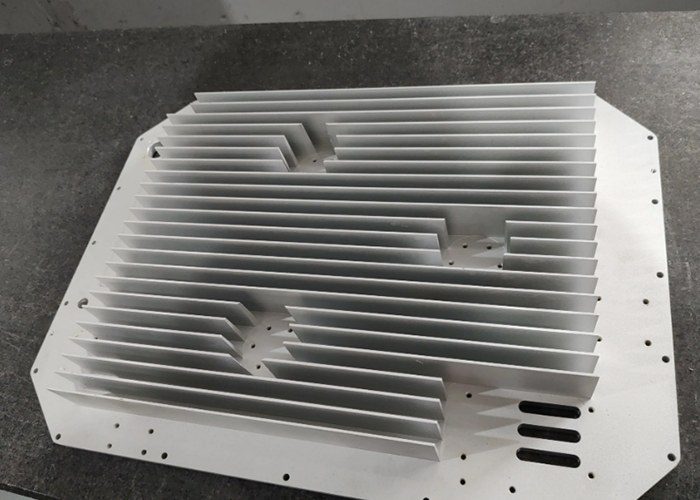
- Heat-sink profiles – integrally milled dense cooling fins and ribs; primarily pure aluminum or 6061, used for power supplies and driver heat sinks.
- Conductive / busbar structures – large flat surfaces, terminal connection points, counterbores, mating faces; made of 1060 pure aluminum or 6061, used for electroplating, electrolytic, and equipment conductive parts.
III. Supplementary Process & Material Selection Notes (Common Shop-Floor Practices)
- Wall thickness principle
Minimum recommended wall thickness for aluminum parts is ≥1.2 mm; walls thinner than 1 mm are prone to chatter and deformation. For frame profiles, prefer thickened walls to increase rigidity. - Surface treatment pairing
- Appearance / corrosion protection: 6061/6063 → standard anodizing (silver gray / black).
- Wear resistance, insulation, high hardness: 6061 → hard anodizing (first choice for jigs and contact/friction surfaces).
- Electrical conductivity needs: conductive oxidation, nickel plating, copper plating.
- Outdoor / corrosive environments: 5052 + thick-layer anodizing.
- Deformation control
For long strips and thin plates, prioritize 6061-T6 over 7075 or pure aluminum. Perform rough machining followed by stress-relief aging before finishing to minimize distortion.