
In the landscape of advanced manufacturing, few material-and-process combinations are as critical—or as challenging—as CNC turning of titanium parts. From the aircraft flying overhead to the medical implants transforming patient care, titanium is quietly enabling some of the most important technological advances of our time. Its unique combination of an exceptional strength-to-weight ratio, inherent corrosion resistance, and complete biocompatibility makes it indispensable for industries where failure is not an option. However, harnessing these remarkable properties requires specialised expertise, as titanium is notoriously one of the most difficult materials to machine.
Understanding the Titanium Challenge
CNC turning is a subtractive manufacturing process in which a rotating workpiece is shaped by a stationary cutting tool, guided by computer numerical control. The process begins with a 3D CAD model, which is converted into G-code using CAM software to automatically control the cutting tool and workpiece. While this process is highly effective for many materials, titanium presents a unique set of obstacles that demand careful planning and execution.
The most significant challenge in turning titanium is its poor thermal conductivity—approximately one-seventh that of aluminium. Heat generated during cutting becomes concentrated at the cutting edge rather than dissipating through the workpiece or chip. This localised heat accumulation rapidly accelerates tool wear and can lead to premature edge failure. One machinist observed that increasing cutting speed by just 10 to 15 percent reduced tool life from 40 passes to a mere 6 passes. Additionally, titanium’s high chemical reactivity causes the material to weld to cutting tools at elevated temperatures, forming a built-up edge that destroys surface finish. Its low elastic modulus—roughly half that of steel—combined with a tendency to spring back during cutting, can induce chatter, poor finishes, and dimensional errors.
Strategies for Successful Titanium Turning
Mastering titanium CNC turning requires a systematic approach encompassing tool selection, cutting parameters, and cooling strategies. Selecting the right cutting tools is paramount. Carbide cutting tools are commonly used due to their high hardness and heat resistance, but specialised carbide grades with fine-grained structures and advanced coatings such as titanium carbonitride (TiCN) and aluminium titanium nitride (AlTiN) offer superior performance for titanium applications. Tool geometry is equally critical—sharp cutting edges and high rake angles minimise cutting forces and reduce the risk of built-up edge formation.
Optimising cutting parameters is essential for balancing material removal with tool life. The core strategy for titanium machining is straightforward: lower cutting speeds combined with relatively high feed rates. This approach ensures the tool shears material efficiently while producing chips thick enough to carry heat away from the cutting zone. For Grade 5 titanium (Ti-6Al-4V), recommended cutting speeds range from 60 to 120 surface feet per minute for roughing and 120 to 180 for finishing. Maintaining a minimum chip thickness of approximately 0.003 inches is critical—insufficient feed rates cause the tool to rub rather than cut, generating excessive heat and work-hardening the surface.
Effective cooling is non-negotiable when turning titanium. High-pressure coolant systems, ideally delivering 100 to 150 bar internally through the tool, help manage temperatures and evacuate chips efficiently. Advanced cooling techniques such as minimum quantity lubrication (MQL) and supercritical CO₂ cooling are also being explored to enhance machinability and process stability.
Key Titanium Grades and Applications
Understanding the nuances of different titanium grades is essential for successful machining. Grade 2 commercially pure titanium offers excellent corrosion resistance and moderate strength, making it suitable for chemical processing equipment. The workhorse Ti-6Al-4V (Grade 5), containing approximately 6 percent aluminium and 4 percent vanadium, accounts for 50 to 70 percent of all titanium in use today. It provides an ideal balance of strength and weight for aerospace components, high-performance automotive parts, and industrial applications. Grade 23 Ti-6Al-4V ELI exhibits the fracture toughness and fatigue life necessary for the long-term reliability of implantable medical devices. Beta-grade titanium alloys, containing additions of iron and chromium, are among the most difficult to machine, with machinability comparable to Hastelloy.
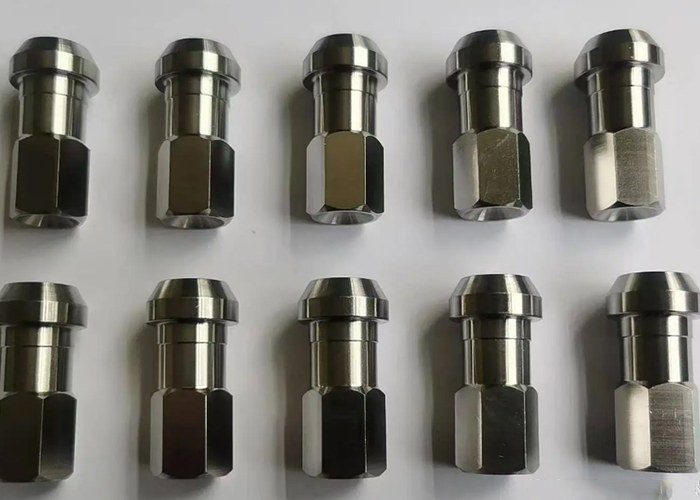
CNC turning is ideal for creating cylindrical or axisymmetric titanium parts such as shafts, bushings, fasteners, bolts, rivets, and flanges. In the aerospace industry, turned titanium components are found in airframe structures, engine fittings, and compressor parts where weight reduction directly translates into fuel savings. In the medical field, titanium’s biocompatibility makes it the material of choice for bone screws, dental implants, neurosurgical components, and endoscopic devices. Swiss-type CNC turning, which supports the workpiece with a guide bushing positioned immediately adjacent to the cutting tool, is particularly well-suited for producing small, high-precision titanium components with high length-to-diameter ratios—such as medical screws and implantable devices.
The Advantages and Future of Titanium CNC Turning
Despite the machining challenges, CNC turning of titanium offers compelling advantages. The process delivers exceptional precision, with modern multi-axis lathes capable of achieving tolerances up to ±0.002mm. It is highly scalable, suitable for both rapid prototyping and high-volume production. The automation inherent in CNC turning reduces labour costs and ensures consistent quality across production runs. Furthermore, the resulting titanium components offer unparalleled durability, corrosion resistance, and—in medical applications—biocompatibility that the human body does not reject.
Driven by the worldwide industrial commitment to enhanced efficiency and sustainable practices, the precision titanium components sector is facing intensifying demand. Advances in cutting tool technology, cooling methods, and machine capabilities are steadily improving the machinability of this extraordinary material. Manufacturers who invest in mastering the art of CNC turning titanium are not merely solving a machining problem—they are positioning themselves at the forefront of modern industrial innovation, delivering components that enable the most critical advances of our time.


