In the vast ecosystem of modern manufacturing, few components are as universally essential as the humble shaft. From the engine of a passenger car to the turbine of a jet aircraft, shafts transmit power, support rotating assemblies, and enable motion across virtually every mechanical system. At the heart of producing these critical components lies CNC turning — a subtractive manufacturing process that has revolutionized how industry creates precision cylindrical parts.
Understanding CNC Turning for Shaft Production
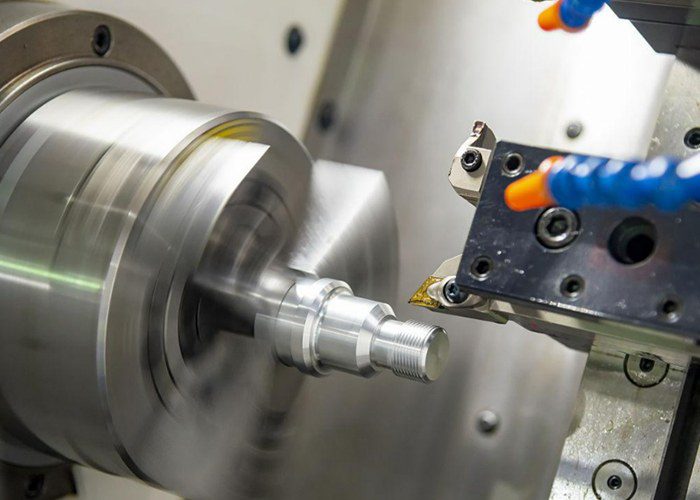
CNC turning is a machining process in which a cylindrical workpiece rotates at high speed while computer-controlled cutting tools remove material to achieve the desired shape, diameter, and surface finish. Unlike CNC milling — where the cutting tool rotates and the workpiece remains stationary — turning spins the workpiece itself, making it inherently suited for rotationally symmetrical parts like shafts, bushings, and pins.
The process begins with CAD modeling, where engineers design the shaft’s geometry. This design is then converted into G-code through CAM software, which generates precise toolpaths that dictate spindle speed, feed rate, and cutting depth. The raw material — typically a cylindrical bar of metal or plastic — is loaded into the lathe’s chuck and secured tightly. As the spindle rotates the workpiece at speeds that can reach thousands of RPM, cutting tools move along the X-axis (radial) and Z-axis (lengthwise) to carve the programmed design.
The machining sequence typically proceeds in stages: roughing passes remove the bulk of excess material to establish the general shape, followed by finishing passes that achieve final dimensional accuracy and surface quality. Modern CNC lathes feature tool turrets that hold multiple cutting tools and index automatically, enabling operations such as facing, threading, grooving, and boring to be completed in a single cycle without manual intervention.
Materials, Tolerances, and Surface Finishes
CNC turning shaft parts can be manufactured from a wide array of materials, each selected based on the application’s specific demands for strength, wear resistance, corrosion resistance, and weight. Common materials include various grades of steel (carbon steel, alloy steel, stainless steel), aluminum alloys, brass, titanium, copper alloys, and engineering plastics such as PEEK and acetal. The material choice directly influences cutting parameters, tool selection, and achievable surface quality.
The precision achievable through CNC turning is one of its defining advantages. Dimensional tolerances for shaft parts typically range from ±0.01 mm to ±0.005 mm, with some high-precision applications achieving even tighter control. Concentricity — the alignment of multiple cylindrical features along a common axis — is critical for shaft performance, as even minor deviations can cause vibration, premature wear, and reduced service life in rotating assemblies. Surface finishes can be held to Ra 0.4 μm or better through optimized cutting parameters and finishing passes.
Diverse Applications Across Industries
CNC-turned shaft parts are indispensable across virtually every sector of modern industry. In the automotive sector, they serve as engine camshafts and crankshafts, transmission shafts, drive shafts, and differential components — parts that must withstand high temperatures, heavy loads, and continuous operation. The aerospace industry relies on precision-turned shafts for landing gear components, engine fittings, and structural applications where lightweight construction and extreme reliability are paramount.
Beyond these flagship industries, turned shafts are found in industrial machinery (pumps, compressors, gearboxes), medical devices, robotics, electronics, and energy systems. Hollow shafts, for example, offer weight reduction while allowing the passage of fluids or cables, making them valuable in lightweight construction and drive technology. Stepped shafts with multiple diameters along a single axis accommodate bearings, gears, and pulleys at different positions. Threaded shafts, grooved shafts, and keyed shafts add further functional complexity to meet specific design requirements.
Quality Control: The Final Frontier
The reliability of any shaft depends not only on its machining but on the rigor of inspection that follows. Quality control protocols typically involve multi-stage inspection using calibrated instruments: digital micrometers and calipers verify dimensional tolerances; coordinate measuring machines (CMMs) provide comprehensive geometric analysis; optical comparators and surface roughness testers ensure finish quality. Runout — the total indicator reading of a rotating shaft’s deviation — is measured to prevent vibration and misalignment in service. Many manufacturers implement 100% inspection for critical features, ensuring that every shaft leaving the facility meets its specified requirements.
The Competitive Edge of CNC Turning
The advantages of CNC turning for shaft production extend beyond precision. The automated, program-controlled nature of the process ensures exceptional repeatability — every shaft in a production run matches the first, minimizing human error and reducing defect rates. For medium to high-volume production, CNC turning offers significant cost advantages over manual machining, with faster cycle times, reduced labor costs, and lower per-unit expenses. Multi-axis and Swiss-type lathes further enhance capabilities, enabling complex geometries and high-volume production of small-diameter shafts.
As manufacturing continues to evolve toward Industry 4.0, CNC turning technology advances in tandem — embracing smart features, real-time parameter optimization, and hybrid machines that combine turning with other processes in a single setup. Yet the fundamental role of the turned shaft remains unchanged: it is the quiet workhorse that keeps the mechanical world in motion. From the smallest motor shaft to the largest drive shaft, CNC turning delivers the precision, consistency, and reliability that modern industry demands.