No manufacturing process rivals CNC turning for its combination of fundamental importance and remarkable flexibility. While CNC milling often captures the spotlight for its ability to create complex, multi-faceted geometries, CNC turning is the quiet workhorse that produces the cylindrical parts keeping our world in motion—from the humble bolts in our furniture to the critical shafts in jet engines. As a subtractive manufacturing process, CNC turning uses computer numerical control to guide cutting tools that remove material from a rotating workpiece, shaping it into highly precise, rotationally symmetrical components.
The Core Mechanism: How It Works
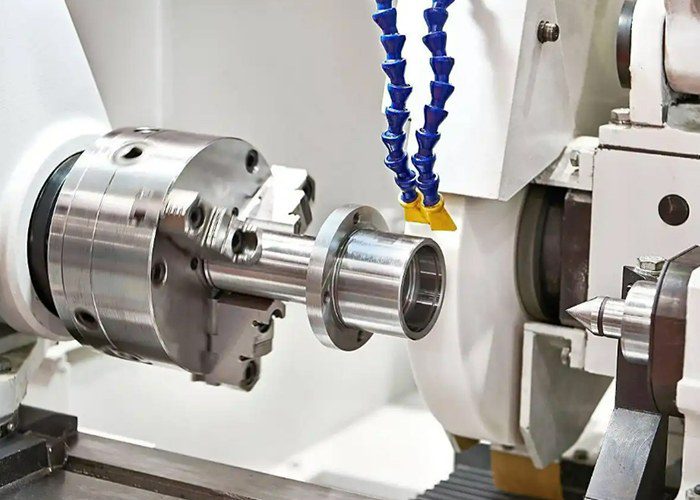
The principle of turning is ancient, with roots tracing back to the Bronze Age. However, the integration of computer numerical control has transformed this age-old craft into a marvel of precision engineering. In a CNC turning center, the fundamental workflow is deceptively simple yet profoundly precise. A cylindrical blank is securely clamped into a chuck or collet. The spindle then rotates this workpiece at high speeds—often thousands of revolutions per minute—while a stationary cutting tool, held in a turret, moves along linear axes to carve out the programmed design.
This process is typically executed in two primary stages: roughing and finishing. Roughing passes quickly remove the bulk of the excess material to establish the general shape. This is followed by finishing passes, which fine-tune the details to achieve the part’s final dimensions and surface quality. In modern CNC turning, tolerances can be held as tight as ±0.025 mm, with surface finishes reaching 0.8–3.2 μm Ra. Some advanced machines can even achieve tolerances of 0.0001 inches.
The Precision Workflow: From Concept to Component
The journey from a raw material to a finished turned part is a meticulously orchestrated sequence of stages. It begins with process planning and technical preparation, where engineering drawings are analyzed, and the machining strategy is defined. This critical phase involves evaluating the part’s geometry for potential interference or deformation risks, selecting the optimal material grade, and designing fixtures and tooling systems that provide the necessary rigidity for high-speed operations.
The second stage is CNC programming and machine setup, where the process plan is converted into machine-executable instructions. This typically involves using Computer-Aided Manufacturing (CAM) software to generate toolpaths. While programmers can write G-code directly, it is more common to use CAM software to define the toolpaths, cutting parameters, and tool change logic. Before any metal is cut, the program is rigorously verified through simulation to detect potential collisions or errors. Once verified, the machine’s coordinate system, tool offsets, spindle speed, and feed rates are configured.
The core of the entire workflow is the machining execution stage. This is typically divided into three distinct phases: roughing, semi-finishing, and finishing. Each phase uses progressively lighter cuts and more precise tools to shape the part to its final geometry and surface quality. Common operations performed during this stage include facing, turning, grooving, threading, and drilling.
Unmatched Advantages and Diverse Applications
The widespread adoption of CNC turning across industries is driven by its significant advantages. The process delivers exceptional precision and accuracy, capable of producing parts with extremely tight tolerances. Its automated nature ensures unmatched consistency and repeatability, making every part in a production run identical—a critical requirement for mass production. This high accuracy translates into reduced waste and lower per-part costs by minimizing rework. Furthermore, modern CNC turning centers are incredibly versatile, capable of machining a wide range of materials, including various metals like aluminum, steel, and brass, as well as plastics and composites.
This versatility makes CNC turning indispensable across numerous sectors. In the automotive industry, it is critical for manufacturing engine components like crankshafts and camshafts, as well as transmission and chassis parts. The aerospace sector relies on it for high-strength, lightweight components that must meet stringent safety standards. In medical device manufacturing, CNC turning produces precision implants, surgical instruments, and orthopedic components with exceptional accuracy and biocompatibility. It is also fundamental in producing standard fasteners, fluid control components, and various mechanical parts like shafts, bushings, and bearings.
The Future: Evolution and Integration
CNC turning is not a static technology. The market for precision turned products is substantial and growing, valued at over $121 billion in 2025, with CNC processes commanding a dominant 65.98% market share. The future of turning lies in greater integration and intelligence. Modern turning centers increasingly feature live tooling, Y-axes, and counter spindles, enabling 6-sided complete machining that can perform milling, drilling, and tapping operations in a single setup. This reduces throughput times and frees up capacity on other machines. The industry is also moving towards “intelligent turning,” which integrates sensor monitoring, data analysis, and automatic control to further enhance precision and process reliability. Trends such as digital twins, tool life analytics, and robotic automation are set to define the next generation of CNC turning, making it smarter, faster, and more efficient than ever before.
In conclusion, CNC turning processing remains a cornerstone of modern manufacturing. By combining an ancient principle with cutting-edge computer control, it delivers the precision, consistency, and efficiency required to produce the countless cylindrical components that form the backbone of our industrial world. As the technology continues to evolve, its role in shaping the future of production is assured.