
In the vast ecosystem of modern manufacturing, few processes are as vital, versatile, or widely used as CNC turning. While 3D printing and laser cutting often grab headlines, it is the quiet, relentless precision of CNC turning that produces the millions of cylindrical metal parts powering our cars, planes, medical devices, and household appliances. From tiny watch pins to large hydraulic shafts, CNC turning metal parts is the unsung hero of industrial production.
At its core, CNC turning is a subtractive machining process. Unlike additive methods that build material, turning removes it. A cylindrical piece of metal—be it aluminum, stainless steel, brass, or titanium—is rotated at high speed while a stationary cutting tool traverses along the workpiece, shaving off material to create the desired shape. The “CNC” (Computer Numerical Control) aspect means every movement is dictated by precise digital code. This marriage of high-speed rotation and computer-guided accuracy is what gives CNC turning its remarkable capabilities.
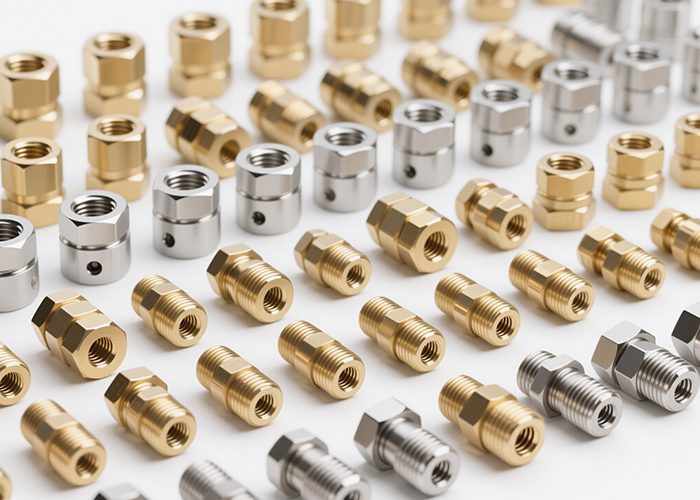
The Anatomy of the Process
Imagine a bar of 6061 aluminum, rough and unformed. It is loaded into the chuck of a CNC lathe—the machine that performs turning operations. The chuck spins the bar at, say, 1,500 RPM. Meanwhile, a carbide cutting tool, programmed with exact coordinates, moves along the X and Z axes. In just seconds, the rough bar transforms: a smooth outer diameter is created, a precise internal hole is bored, and a chamfer is added to break the sharp edge. With live tooling capabilities on modern CNC turning centers, the machine can even mill flats, drill cross-holes, or thread the part without ever removing it from the chuck. This ability to complete multiple operations in a single setup is a game-changer for efficiency and accuracy.
CNC turning produces two primary types of shapes: external profiles (like stepped shafts, pulleys, or rollers) and internal features (such as bushings, sleeves, or threaded bores). Common operations include facing (creating a flat end), turning (reducing diameter), boring (enlarging an existing hole), drilling, threading, and knurling (adding a textured grip pattern).
Why Choose CNC Turning for Metal Parts?
The advantages of CNC turning over traditional manual turning or other machining methods are substantial.
First is precision and repeatability. A well-maintained CNC lathe can hold tolerances within ±0.0005 inches (0.0127 mm) or better. Once the program is proven, the machine will produce the thousandth part exactly as perfect as the first. For industries like aerospace or medical devices, where a fraction of a millimeter can mean life or death, this reliability is non-negotiable.
Second is complexity without compromise. CNC turning excels at producing parts with complex geometries—tapered diameters, eccentric turning, grooved profiles, and non-round features (via interpolation or live tooling). The software can seamlessly transition between operations, creating parts that would be impossible or prohibitively expensive to produce on manual equipment.
Third is efficiency and unattended operation. Modern CNC turning centers can run lights-out for hours or even overnight. With automatic bar feeders, part catchers, and tool life monitoring, a single machine can produce hundreds of completed parts while the machinist sleeps. This dramatically lowers the cost per part, especially for medium to high production runs.
Materials in the Spotlight
The versatility of CNC turning is further demonstrated by the range of machinable metals. Aluminum (especially 6061 and 7075) is a favorite for lightweight, high-speed applications like drone components and automotive parts. Stainless steel (303, 304, 316) offers corrosion resistance and strength, ideal for medical instruments and food-grade equipment. Brass and copper are prized for electrical conductivity and aesthetic finish, common in plumbing fittings and electronic connectors. For extreme strength and heat resistance, titanium and Inconel are turned, though these require specialized tooling and slower speeds due to their work-hardening tendencies. Each material demands specific cutting speeds, feeds, and coolant strategies.
Real-World Applications
One cannot appreciate CNC turning without understanding its end products. In the automotive industry, it produces engine valves, transmission shafts, brake pistons, and wheel hubs. In aerospace, it creates landing gear components, hydraulic fittings, and actuator housings. The medical field relies on turned parts for bone screws, surgical pins, and the tiny components of robotic surgery tools. Even in everyday consumer goods, your printer rollers, smartphone lens housings, and faucet cartridges were likely turned on a CNC lathe.
Challenges and Considerations
Despite its power, CNC turning is not without challenges. The initial investment in a production-grade CNC turning center can exceed $100,000, and programming requires skilled engineers. Setup time for complex parts can be substantial, making extremely small runs (1–10 pieces) less cost-effective. Additionally, material waste—in the form of chips—is inherent to subtractive manufacturing, though most shops recycle swarf.
The Future of CNC Turning
As Industry 4.0 advances, CNC turning is evolving. Smart lathes now integrate IoT sensors that monitor tool wear, vibration, and temperature in real time, adjusting feeds to optimize tool life. Hybrid machines combine turning with additive metal deposition, allowing for repairs or custom features impossible with subtraction alone. And with AI-driven CAM (computer-aided manufacturing) software, programming times are shrinking dramatically, making small-batch turning more accessible.
Conclusion
CNC turning metal parts is far more than a manufacturing process; it is a foundational technology that enables modern civilization. Whether you are holding a stainless steel valve body or admiring a polished aluminum wheel rim, you are seeing the legacy of a spinning chuck and a precisely guided cutting tool. As materials improve and machines become smarter, CNC turning will remain an indispensable tool—silently, precisely, and reliably shaping our world, one revolution at a time.


