
In the landscape of contemporary manufacturing, few processes have proven as transformative as CNC (Computer Numerical Control) machining. Among the most versatile and indispensable categories within this domain are CNC turned and milled parts—components that embody the synthesis of two fundamental machining disciplines. By combining the rotational precision of turning with the geometric flexibility of milling, these parts have become the bedrock of industries ranging from aerospace and automotive to medical devices and energy. This article explores the technology behind CNC turned and milled parts, their distinct advantages, and their profound impact on modern production.
Understanding the Dual Processes
At its core, CNC machining is a subtractive manufacturing technology that uses computer-controlled tools to remove material from solid stock, producing parts with precise dimensions. The process relies on two primary methods: turning and milling. CNC turning is performed on a lathe, where the workpiece rotates at high speed while a stationary cutting tool shapes it into cylindrical or conical geometries. This method excels at producing rotationally symmetrical components such as shafts, pins, and threaded parts. In contrast, CNC milling employs a rotating cutting tool to remove material from a stationary workpiece, making it ideal for flat surfaces, pockets, slots, and complex three-dimensional contours.
The fundamental difference lies in motion: in turning, the workpiece rotates and the tool feeds linearly; in milling, the tool rotates and the workpiece moves beneath it along controlled axes. While each process has its strengths—turning for round, symmetric parts and milling for prismatic and irregular geometries—their combination unlocks unprecedented manufacturing capabilities.
The Rise of Turn-Mill Technology
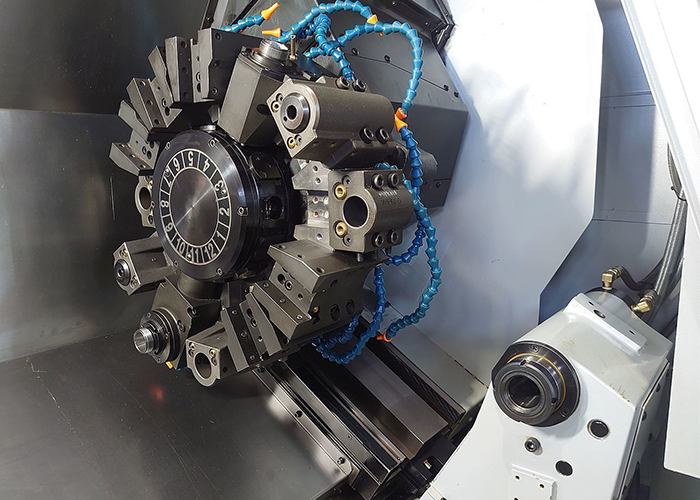
The advent of turn-mill technology marks the definitive revolution in CNC machining, seamlessly combining both turning and milling capabilities within a single machine. These advanced machining centers combine the functionality of a CNC lathe—rotating the workpiece—with the machining capabilities of a CNC milling machine, including drilling, tapping, and multi-axis operations. Live tooling lathes incorporate end mill cutting tools and drills to produce off-axis features without the need to change platforms.
This integrated approach offers profound advantages. By performing turning, milling, drilling, and tapping in a single setup, manufacturers eliminate the need to transfer workpieces between different machines. This reduces setup times, improves precision, and enhances overall productivity. The elimination of repositioning operations reduces concentricity errors and helps maintain tighter tolerances. Components that once required multiple setups and machining operations can now be completed on a single machine using a unified program.
Superior Precision and Quality
One of the most compelling advantages of CNC turned and milled parts is their exceptional precision. By completing multiple operations in a single setup, manufacturers can significantly reduce the dimensional errors that often result from repeated handling, repositioning, and realignment procedures. This is especially critical when manufacturing components with tight tolerances, critical functional surfaces, or complex geometries.
Modern CNC turning centers can produce reproducible components with tolerances of up to ±0.01 mm and surface roughness as fine as Ra 0.8 µm. CNC milling achieves ±0.02 mm precision as standard, with high-precision environments reaching tolerances within a few microns. The integration of turning and milling in a single machine further enhances these capabilities, enabling manufacturers to achieve tighter tolerances and better surface finishes while reducing the risk of errors and inconsistencies.
Versatile Applications Across Industries
The versatility of CNC turned and milled parts is evident in their wide-ranging applications. In the aerospace industry, these machines are deployed to manufacture turbine blades, engine parts, landing gear components, and complex structural elements—capable of executing both cylindrical turning and the sophisticated milling of intricate contours, pockets, and bores. Complex rotary parts such as turbine discs, impellers, and gas turbine blades benefit tremendously from turn-mill technology, which can complete multiple processes in a single setup, including turning the outer diameter, milling the blade profile, and drilling holes.
The automotive sector relies on CNC turned and milled parts for crankshafts, camshafts, transmission components, steering system parts, and suspension components. Precision shaft parts such as automotive drive shafts, motor shafts, and crankshafts require extremely high coaxiality and surface roughness—demands that turn-mill machining meets through synchronous or alternating processing.
In medical technology, these processes manufacture orthopedic implants, prosthetics, surgical instruments, and dental components. Artificial joints and dental implants can achieve surface roughness controllable to below Ra 0.8μm. The oil and gas industry utilizes turned and milled parts for valves, connectors, and drill bits, ensuring the necessary strength and functionality for harsh operating conditions. General engineering applications span shafts, bushings, fittings, couplings, and custom-designed components.
Materials and Manufacturing Considerations
CNC turned and milled parts are manufactured from a diverse range of materials, each selected for its specific properties. Common metals include aluminum (6061 and 7075), stainless steel (SUS304), brass, copper, steel alloys, and titanium. Plastics and composites such as acetal, ABS, G-10, PEEK, and PTFE are also machined. The ability to work with difficult-to-machine materials like titanium alloys and high-temperature alloys is particularly valuable in aerospace and medical applications.
The Role of Advanced CAM Software
Realizing the full potential of turn-mill technology requires equally advanced CAM (Computer-Aided Manufacturing) software. Mill-turn programming software is designed to optimize machining sequences, automate toolpaths, and ensure seamless transitions between milling and turning operations. Sub-spindle functionality facilitates continuous part flow, allowing both ends to be machined simultaneously. Machine simulation allows manufacturers to verify tool paths, detect collisions, and validate the entire machining process before production begins, reducing the risk of errors and material waste.
Future Trends and Industry 4.0
The market for CNC turned and milled parts continues to grow robustly. The metal precision turned product manufacturing market is projected to grow from USD 104.11 billion in 2025 to USD 142.66 billion by 2031. Several key trends are shaping this growth, including the rise of smart manufacturing and the adoption of Industry 4.0 technologies. CNC machines are increasingly connected to smart factory ecosystems, allowing for real-time monitoring, predictive maintenance, and optimization. Integrating automation, digitalization, and advanced materials streamlines operations, cuts waste, and boosts product quality. Multi-axis machining capabilities continue to expand, with 5-axis turn-mill centers enabling complete six-sided machining and true freeform milling in a single clamping.
Conclusion
CNC turned and milled parts represent the pinnacle of modern precision manufacturing. By seamlessly integrating the rotational efficiency of turning with the geometric versatility of milling, turn-mill technology has revolutionized how complex components are produced. The ability to complete multiple operations in a single setup delivers superior precision, reduced cycle times, and significant cost savings. From aerospace turbines to medical implants, from automotive drivetrains to energy infrastructure, these parts are indispensable to the technologies that define the modern world. As Industry 4.0 continues to evolve and manufacturing becomes increasingly automated and data-driven, CNC turned and milled parts will remain at the forefront of industrial innovation—precise, versatile, and essential.


