In the intricate world of mechanical engineering and manufacturing, few components are as unassuming yet indispensable as the humble bushing. Often overlooked in favor of flashier parts, bushings play a critical role in reducing friction, guiding moving components, and absorbing vibration. When manufactured using Computer Numerical Control (CNC) precision machining, bushings transcend their simple appearance to become high-performance elements that define the reliability and longevity of countless machines. This article delves into the processes, materials, advantages, and applications of CNC precision machining bushings, offering a thorough understanding of why they are essential to modern industry.
What is a Bushing?
A bushing, also known as a plain bearing or sleeve bearing, is a cylindrical lining designed to provide a low-friction interface between two moving parts. Unlike rolling-element bearings that use balls or rollers, bushings rely on sliding contact. They are commonly used to support rotating shafts, reduce wear, maintain alignment, and dampen noise and vibration. Bushings can be found in everything from automotive suspension systems and hydraulic pumps to electric motors, agricultural equipment, and aerospace actuators.
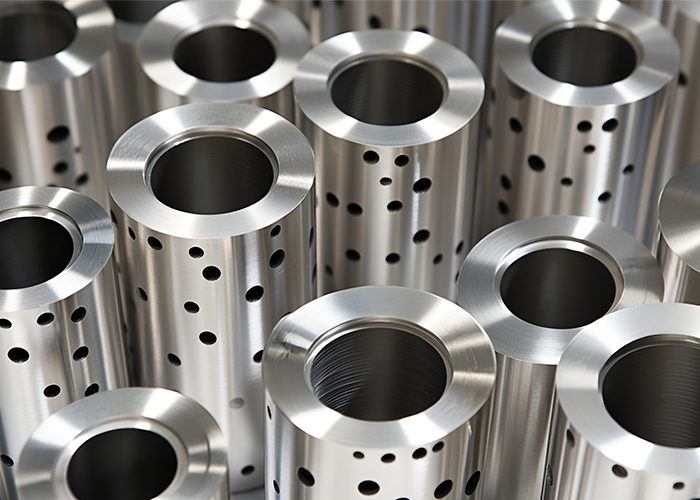
The CNC Precision Machining Difference
Traditional bushing manufacturing methods—such as manual turning, casting, or powdered metal sintering—often struggle to achieve the tight tolerances and complex geometries demanded by modern engineering. CNC precision machining revolutionizes this process by using computer-controlled lathes, milling machines, and grinding equipment to produce bushings with exceptional accuracy. Typical tolerances for CNC-machined bushings range from ±0.005 mm to as tight as ±0.001 mm, depending on the application.
The process begins with a solid bar or tube of raw material—most often metal, though engineered plastics and composites are also used. A CNC lathe spins the workpiece while a series of cutting tools remove material according to a pre-programmed digital design (CAD/CAM file). Multiple operations can be performed in a single setup: turning the outer diameter, boring the inner diameter, chamfering edges, cutting oil grooves, drilling lubrication holes, and even threading ends. For more complex shapes, CNC milling centers add features like flats, slots, or cross-holes.
Materials for CNC Machined Bushings
Choosing the right material is paramount to bushing performance. CNC machining allows a wide variety of materials to be shaped precisely:
- Bronze alloys (e.g., C93200, C95400): The most common bushing material due to excellent wear resistance, embeddability (ability to trap debris), and compatibility with steel shafts.
- Brass: Used for lower-load, corrosion-resistant applications such as instruments or marine equipment.
- Aluminum: Lightweight and suitable for moderate loads, often in automotive and aerospace contexts.
- Steel and stainless steel: For high-load, high-temperature, or corrosive environments; stainless grades (303, 304, 316) offer superior rust resistance.
- Engineered plastics (PEEK, PTFE, nylon, acetal): Self-lubricating, chemically inert, and quiet; ideal for food processing, medical devices, or where metal-to-metal contact is undesirable.
- Composite materials: Often a metal backing with a porous bronze layer and PTFE liner, combining strength with low friction.
CNC machining enables precise cutting of even hard or brittle materials without the thermal damage that can occur with other methods.
Key Advantages of CNC Precision Machined Bushings
Why do engineers specify CNC-machined bushings over cast or powdered metal alternatives? The benefits are compelling:
- Unmatched dimensional accuracy – CNC machines hold tolerances impossible with mass-production methods, ensuring consistent fit and function.
- Complex geometries – Oil grooves, spiral lubricant channels, flanges, tapered bores, and asymmetrical features are easily programmed.
- Superior surface finish – Machined surfaces (often 0.4–0.8 μm Ra) reduce initial running-in wear and lower friction.
- Material flexibility – From soft brass to hardened tool steel, CNC machining handles nearly any engineering material.
- Low to medium volume efficiency – While casting excels for millions of parts, CNC machining is cost-effective for batches from one to tens of thousands.
- Rapid prototyping and revision – Design changes require only a software update, not expensive new tooling.
- Elimination of secondary operations – Many features are finished in one clamping, reducing handling and error.
Quality Control and Inspection
Precision bushing manufacturing relies on rigorous inspection. CNC shops employ coordinate measuring machines (CMMs), laser micrometers, air gauges, and bore gauges to verify inner and outer diameters, concentricity, roundness, and surface finish. Statistical process control (SPC) charts track production runs to detect trends before parts go out of spec. For critical applications like aerospace or medical devices, 100% inspection and material certifications are standard.
Applications Across Industries
The versatility of CNC precision machining bushings makes them ubiquitous:
- Automotive: Engine timing components, transmission shafts, steering columns, brake calipers, and suspension linkages.
- Aerospace: Flight control actuators, landing gear pivot points, hydraulic pumps, and engine accessories—where reliability under extreme temperatures and vibration is non-negotiable.
- Industrial machinery: Conveyor rollers, gearboxes, printing presses, packaging equipment, and injection molding machines.
- Medical devices: Surgical instruments, orthopedic implants (often with specialized biocompatible coatings), and diagnostic equipment.
- Renewable energy: Wind turbine pitch control systems, solar tracker joints, and hydroelectric turbine bearings.
- Oil and gas: Downhole tools, blowout preventers, and valve actuators operating in high-pressure, abrasive environments.
- Consumer products: Power tools, office equipment, exercise machines, and even high-end faucets.
The Future of CNC Machined Bushings
As manufacturing technology evolves, so do bushings. Multi-axis CNC machines allow for one-hit machining of extremely complex bushings with internal contours, while Swiss-type lathes produce tiny bushings for micro-devices. The integration of in-process gauging and adaptive control ensures even tighter tolerances. Meanwhile, advanced materials like ceramic-reinforced polymers and diamond-like carbon (DLC) coatings push the limits of wear life and temperature resistance.
Additive manufacturing (3D printing) is beginning to complement CNC machining for prototyping or creating internal lattice structures for lightweighting, but for precision, surface finish, and material integrity, CNC machining remains the gold standard.
Conclusion
CNC precision machining bushings may be small and simple in appearance, but they represent a convergence of materials science, precision engineering, and computer-controlled manufacturing. Whether enabling a car to steer smoothly, a plane to land safely, or a surgical robot to make microscopic movements, these components perform their silent duty with remarkable reliability. For engineers and designers, understanding the capabilities and limitations of CNC-machined bushings is essential to creating machines that are durable, efficient, and precise. As industries continue to demand higher performance from ever-smaller packages, the precision-machined bushing will remain a cornerstone of mechanical design.