Introduction
In the vast ecosystem of modern manufacturing, few processes are as foundational or as transformative as CNC Lathe Turning. Standing for Computer Numerical Control, CNC lathe turning has evolved from the manually operated engine lathes of the Industrial Revolution into a highly sophisticated, automated process capable of producing complex cylindrical parts with micron-level precision. Whether it is the drive shaft in your car, the medical bone screw in an orthopedic implant, or the nozzle in a jet engine, countless components owe their existence to the remarkable capabilities of the CNC lathe.
This article explores the mechanics, advantages, applications, and future trends of CNC lathe turning, illustrating why it remains the backbone of subtractive manufacturing.
The Fundamental Mechanics of CNC Lathe Turning
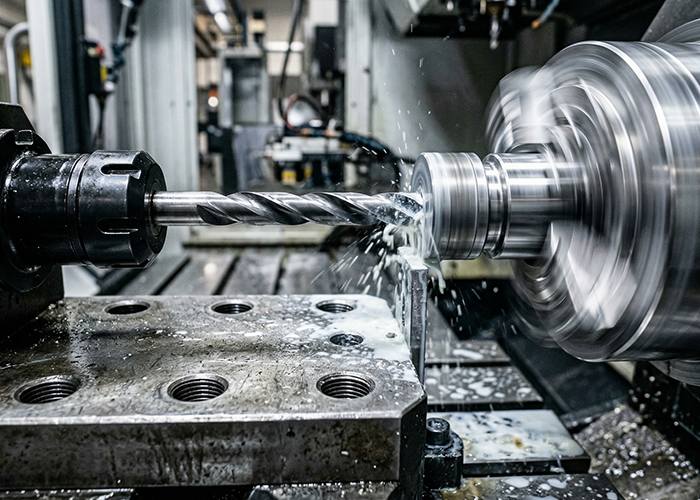
At its core, turning is a subtractive manufacturing process. Unlike 3D printing (additive), which builds material up, turning cuts material away. The fundamental principle is deceptively simple: the workpiece rotates at high speeds while a stationary cutting tool traverses linearly along its surface. In a CNC lathe, this movement is dictated by G-code—a precise set of numerical instructions that control every axis, spindle speed, feed rate, and coolant flow.
Modern CNC lathes typically feature two primary axes: the X-axis (controlling the diameter) and the Z-axis (controlling the length). More advanced models, known as live-tooling lathes or mill-turn centers, incorporate the Y-axis and C-axis, allowing the machine to perform milling, drilling, and tapping operations without removing the part from the chuck. This “done-in-one” capability is a game-changer for manufacturing efficiency.
The process begins when a cylindrical billet (metal, plastic, or composite) is secured in the chuck. As the spindle accelerates to the programmed RPM, the turret—a rotating tool holder—positions the appropriate insert against the material. By orchestrating the precise depth of cut and feed rate, the lathe can generate external features (diameters, tapers, contours) and internal features (holes, bores, threads) with equal finesse.
Key Advantages Over Conventional Turning
Why has CNC turning almost completely replaced manual turning in high-production environments? The advantages are compelling:
- Unparalleled Precision and Repeatability: A skilled manual machinist might hold a tolerance of ±0.001 inches on a good day. A CNC lathe routinely holds ±0.0002 inches (±5 microns) across thousands of parts. Once a program is verified, the 1000th part will be identical to the first.
- Complex Geometry Made Simple: Manual lathes struggle with complex contours, spherical radii, or non-linear tapers. CNC lathes use interpolation to follow any mathematically defined path. From ovoid shapes to intricate grooves, complexity adds little to production time.
- Reduced Human Error and Labor Costs: While one operator can run only one manual lathe at a time, a single CNC operator can monitor three or four automated machines, intervening only for tool changes or quality checks. Automation also eliminates fatigue-induced mistakes.
- 24/7 Production: CNC lathes are designed for lights-out manufacturing. With automatic bar feeders and part catchers, they can run unattended overnight, dramatically increasing throughput.
Critical Applications Across Industries
The versatility of CNC lathe turning makes it indispensable across multiple sectors:
- Automotive: Engine pistons, brake rotors, transmission shafts, and wheel hubs. High-volume turning with carbide inserts keeps the automotive supply chain moving.
- Aerospace: Landing gear components, hydraulic fittings, and turbine engine casings. These demand exotic alloys (Inconel, Titanium) that require rigid, high-torque CNC lathes with specialized coolant systems.
- Medical: Bone screws, surgical shavers, dental implants, and joint replacement components. These parts often require Swiss-style CNC lathes, a subset of turning that uses a sliding headstock and guide bushing to produce extremely long, slender, and tiny parts (down to 0.2mm diameter).
- Oil & Gas: Valve bodies, drill pipe connectors, and pump shafts. These large-scale parts often require “big-bore” CNC lathes with through-spindle capacities exceeding 10 inches.
Tooling and Material Considerations
Success in CNC turning heavily depends on the cutting tool. The most common materials for inserts include High-Speed Steel (HSS) for hobby work, Carbide for 90% of industrial applications, and Ceramics or CBN (Cubic Boron Nitride) for superalloys and hardened steel above 45 HRC.
The geometry of the insert—its chip breaker, rake angle, and nose radius—must be matched to the material being cut. For instance, turning aluminum requires a sharp, polished insert with a high rake angle and a large chip breaker to prevent built-up edge (BUE). Turning stainless steel, conversely, needs a tougher, more heat-resistant grade with a smaller chip breaker.
Chip control is a constant challenge. A CNC lathe generates long, stringy chips that can wrap around the part and damage the surface finish or break the tool. Modern machines use high-pressure coolant (up to 1000 PSI) directed precisely at the cutting zone to fracture chips into small, manageable “C” or “6” shapes that fall harmlessly into the chip conveyor.
Challenges and Limitations
Despite its power, CNC turning is not a universal solution. It is inherently inefficient for non-cylindrical primary shapes (a square block is better milled). Set-up time can be significant: programming, selecting tools, and proving out the first part may take hours, making it uneconomical for single prototypes unless the geometry is highly complex.
Furthermore, the initial capital investment is high. A quality production CNC lathe with live tooling and a bar feeder can cost over $150,000. This requires a solid return-on-investment calculation, usually justified by high-volume production runs.
The Future: Smart Turning and Hybrid Manufacturing
The next generation of CNC lathe turning is digital. Industry 4.0 lathes feature embedded sensors that monitor vibration, temperature, tool wear, and spindle load in real time. Adaptive control systems can automatically adjust feed rates to compensate for tool wear, extending tool life by up to 40%.
Hybrid manufacturing is also emerging—combining additive (laser metal deposition) with subtractive (turning) in the same machine. This allows repair of worn components (e.g., rebuilding a damaged journal on a shaft) and then finish-turning it to pristine specifications, all in one setup.
Conclusion
CNC lathe turning is far more than a simple method of making round parts. It is a symphony of precision mechanics, advanced software, and materials science. From the tiny screws in a pacemaker to the massive shafts driving a ship’s propeller, CNC turning quietly underpins the physical world we inhabit. As the technology continues to evolve with AI-driven process optimization and hybrid capabilities, one truth remains constant: the lathe, in its CNC form, is still the king of the machine shop.