
In the rapidly evolving landscape of robotics, where the difference between a breakthrough and a breakdown is often measured in microns, the manufacturing process matters as much as the software that runs the machine. At the heart of this industrial revolution lies a subtractive manufacturing workhorse: CNC Milling. When it comes to producing high-performance robot parts, CNC milling is not merely a fabrication method; it is the critical enabler of precision, durability, and structural integrity.
The Anatomy of Robotic Precision
Robots, whether they are industrial articulated arms handling 500 kg car chassis or delicate surgical micro-robots navigating human anatomy, rely entirely on their mechanical structure. The “skeleton” and “joints” of these machines demand tolerances that 3D printing or traditional casting often cannot guarantee. This is where Computer Numerical Control (CNC) milling asserts its dominance.
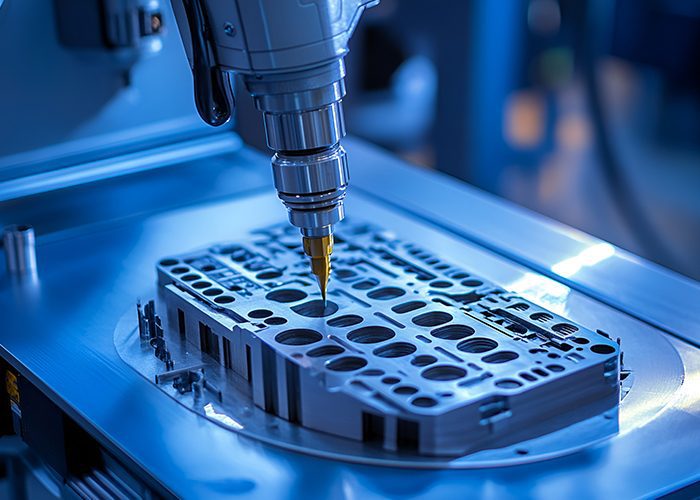
CNC milling utilizes rotating multi-point cutting tools to remove material from a solid block—or “blank”—of metal or engineering-grade plastic. For robotic applications, this process achieves tolerances as tight as ±0.005 mm (5 microns). In robotics, such precision eliminates “backlash”—the slight gap that causes wobbling in gears and joints. For a robotic arm repeating the same task 24 hours a day, eliminating mechanical slop is the difference between a successful pick-and-place operation and a dropped component.
Material Versatility for Demanding Environments
Robots operate in harsh environments. From foundries where temperatures soar to cleanrooms where contamination is unacceptable, the materials used must withstand extreme conditions. CNC milling offers unparalleled versatility in material selection, allowing engineers to choose the exact alloy required for the task.
For structural components like robot bases, arms, and wrist housings, 7075 aluminum is a favorite. It offers a strength-to-weight ratio comparable to steel but at a fraction of the weight, which is crucial for reducing the inertia of moving arms. When rigidity is paramount—such as in the gearbox housings that endure high torque—CNC machined stainless steel (304 or 316) or tool steel is used. For collaborative robots (cobots) designed to work alongside humans, machined polyether ether ketone (PEEK) or acetal components provide lightweight, non-conductive solutions that maintain safety without sacrificing structural rigidity.
Complex Geometries for Compact Designs
Modern robotics trends favor compactness. Designers are pushing for smaller footprints with higher payload capacities. This demands components with complex internal geometries that are difficult to produce through traditional manual machining.
CNC milling machines, particularly 5-axis machining centers, excel at producing these intricate parts in a single setup. For instance, a robotic wrist housing typically requires complex contours, internal cooling channels, and precise bearing seats. In a 5-axis CNC mill, the part can be rotated and tilted to allow the cutting tool to reach five sides of the component without manual repositioning. This “single-setup” capability ensures that every feature is perfectly aligned relative to the others. If a part requires multiple setups on a 3-axis machine, slight misalignments accumulate; 5-axis milling eliminates this risk, ensuring that the mounting flange, servo motor pocket, and output shaft are all geometrically perfect relative to one another.
The Role in Actuation and Transmission
Perhaps the most critical application of CNC milling in robotics is in the production of transmission components. Robots move via motors, but they transmit power through precision mechanical components.
Harmonic drives (strain wave gearing) are ubiquitous in advanced robotics due to their zero-backlash characteristics. The flexspline—the thin, cup-shaped component that deforms elastically to transmit motion—is typically CNC machined from high-alloy steel. The manufacturing of this part requires extreme skill; any deviation in the wall thickness or concentricity results in premature failure or inconsistent motion. Similarly, sprockets, timing belt pulleys, and custom gearboxes are almost exclusively produced via CNC milling to ensure that the pitch diameters and tooth profiles match the theoretical design exactly.
Prototyping to Production Scalability
The robotics industry is characterized by rapid iteration. A startup developing a new bipedal robot may go through ten design revisions of a knee joint in six months. CNC milling serves as the bridge between prototyping and mass production.
During the R&D phase, CNC mills can quickly produce one-off parts without the high upfront cost of injection molding dies or casting patterns. Engineers can test the fit, form, and function of a part, then instantly modify the G-code to reflect design changes. Once the design is validated, the same CNC equipment can scale to medium-to-high volume production. With the integration of automated pallet changers and robotic tending systems (ironically, using robots to make robots), CNC machining cells can run 24/7 to produce thousands of identical high-quality components.
Surface Finish and Post-Processing
Robotic parts often require specific surface characteristics beyond just dimensional accuracy. For parts that move against each other—such as linear guide rails or pivot points—surface roughness (Ra) must be minimized to reduce friction and wear. CNC milling achieves superior surface finishes that often eliminate the need for secondary grinding operations.
Furthermore, machined parts are ideal candidates for post-processing treatments essential for robotics. Anodizing of aluminum components provides a hard, non-conductive ceramic layer that is crucial for electrical isolation in sensitive electronic housings. The precise machining ensures that after anodizing, critical datums and threaded holes remain within tolerance.
Conclusion
As we stand on the cusp of widespread automation, the capabilities of robotics are directly tethered to the capabilities of manufacturing. CNC milling remains the gold standard for producing robot parts because it offers the trifecta required for successful automation: uncompromising precision, material integrity, and geometric complexity.
From the structural chassis that provides stiffness under heavy loads to the microscopic gears that articulate a surgical tool, CNC milled components form the physical foundation upon which robotic intelligence acts. While additive manufacturing and other emerging technologies continue to find their niche, the reliability, accuracy, and scalability of CNC milling ensure that it will remain the backbone of robotic manufacturing for decades to come. Every time a robot executes a flawless maneuver, it is a testament to the precision engineering of its parts—shaped one chip at a time by the milling machine.


