
The rapid evolution of robotics has placed unprecedented demands on manufacturing precision, material performance, and production scalability. At the heart of this industrial transformation lies CNC (Computer Numerical Control) machining—a subtractive manufacturing process that has become indispensable for producing high-quality robotic components. From articulated arms and joint housings to end-effectors and sensor mounts, CNC machining delivers the tight tolerances and complex geometries required for modern robots to function reliably in dynamic environments. This article explores the critical role of CNC machining in fabricating robotic parts, its advantages, challenges, material considerations, and emerging trends shaping the future of automation.
Why CNC Machining for Robotic Parts?
Robots operate at the intersection of mechanics, electronics, and control systems. Their performance hinges on components that exhibit minimal mechanical backlash, high stiffness, and excellent fatigue resistance. Traditional manufacturing methods like casting or 3D printing often fall short when it comes to surface finish, dimensional accuracy, or material uniformity. CNC machining, by contrast, offers unmatched precision with typical tolerances ranging from ±0.005 mm to ±0.025 mm. This level of accuracy is essential for parts such as harmonic drive gears, reducer housings, and robotic knuckles, where even microns of deviation can cause vibration, positioning errors, or premature wear.
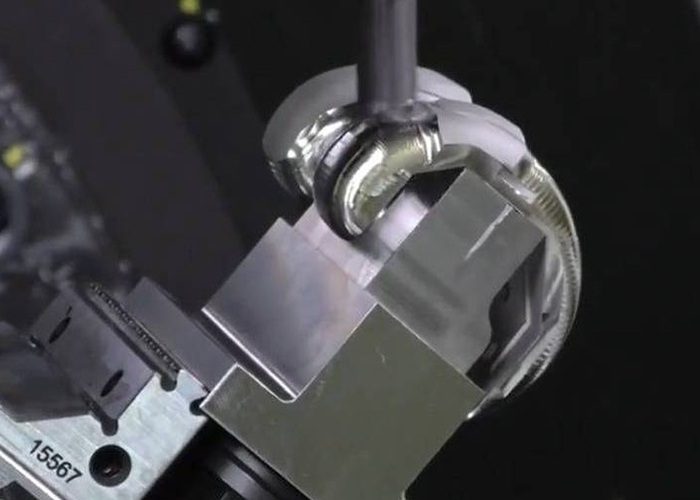
Moreover, CNC machining excels at producing complex 3D contours, internal cavities, and intricate features—such as oil grooves, cooling channels, or threaded holes—that are common in robotic joints and structural links. Multi-axis CNC centers (4-axis and 5-axis) can machine a workpiece from multiple angles in a single setup, reducing errors caused by repositioning and drastically improving consistency.
Typical Robotic Parts Made by CNC Machining
A wide variety of robotic components are routinely produced via CNC milling, turning, or grinding:
- Robot arm links and frames: Usually machined from aluminum 6061-T6 or 7075-T6 for a high strength-to-weight ratio.
- Joint reducers and cycloidal discs: Require hard turning or precision milling of hardened steel (e.g., 42CrMo4) to achieve gear-like accuracy.
- End-of-arm tooling (EOAT) plates and gripper jaws: Often made of aluminum, stainless steel, or engineering plastics like PEEK or Delrin.
- Motor mounting brackets and sensor housings: Demanding precise hole patterns and flatness for bolt-on assemblies.
- Custom shafts, pins, and bushings: Machined from stainless steel, brass, or bronze for wear resistance.
Material Selection for Robotic CNC Parts
The choice of material directly affects the robot’s payload, speed, and durability. CNC machining allows a wide material palette:
- Aluminum alloys (6061, 7075, 2024): Lightweight, easy to machine, and corrosion-resistant. Ideal for structural frames and moving links.
- Stainless steels (304, 316, 17-4 PH): Used for fasteners, high-stress joints, or components exposed to harsh environments.
- Titanium (Grade 5 Ti-6Al-4V): Premium choice for aerospace-grade robotic parts where strength and weight reduction are critical, albeit more expensive and challenging to machine.
- Engineering plastics (PEEK, PTFE, Acetal, Nylon 6/6): Used for bushings, wear pads, or electrical insulation parts. CNC machining ensures burr-free edges and tight ID/OD tolerances.
- Brass and copper alloys: For conductive components, slip rings, or pneumatic fittings.
Surface Finishes and Post-Processing
After CNC machining, robotic parts often undergo secondary treatments to enhance performance:
- Anodizing (Type II or III) of aluminum improves surface hardness and corrosion resistance.
- Passivation for stainless steel – removes free iron and promotes oxide layer formation.
- Electroless nickel plating – provides uniform lubricity and wear protection for bores.
- Polishing or bead blasting reduces friction and eliminates stress risers.
- Precision grinding – achieves Ra < 0.2 µm surface finish for mating sliding surfaces.
Advantages of CNC Machining over Alternative Processes
- High repeatability: Once the CAM program is validated, hundreds or thousands of identical parts can be produced with minimal variation.
- Low prototyping to production transition: The same CNC setup can run one-offs or full batches, making it ideal for iterative robotic design.
- Excellent material utilization: Unlike 3D printing, which may require internal supports, CNC machining creates parts directly from solid billets, often with better mechanical properties.
- No tooling costs for design changes: Modifying a robot part’s CAD model simply requires updating the G-code, unlike injection molding which demands expensive new molds.
Challenges and Mitigation Strategies
Despite its strengths, CNC machining for robotic parts faces certain hurdles:
- Geometric complexity: Some generative-design or topology-optimized robot links have lattice-like internal structures that are impossible to mill. In such cases, hybrid approaches (CNC + additive manufacturing) are emerging.
- Residual stresses: Aggressive cutting of heat-treated alloys can induce warpage. Using stress-relieving blanks and optimized toolpaths mitigates this.
- Cost for hard materials: Titanium and hardened tool steels require slower speeds, shorter tool life, and specialized coolants, raising part price. However, for mission-critical components, the reliability justifies the expense.
- Lead time for multi-axis programming: Skilled CAM programmers are essential to generate collision-free, efficient toolpaths for 5-axis machining of complex robotic knuckles or curved links.
Future Trends: Smart CNC for Robotics
The convergence of Industry 4.0 and robotics is reshaping CNC machining. Real-time process monitoring using vibration sensors and spindle load analysis allows adaptive feed rates, reducing tool breakage on delicate robotic parts. AI-driven CAM software automatically identifies optimal cutting strategies for thin-walled structures (common in lightweight robot arms). Furthermore, on-machine probing enables in-cycle measurement and compensation, ensuring that each robotic part meets its blueprint without removing it from the workholding.
Another exciting development is the use of CNC machining to produce parts for collaborative robots (cobots) with rounded edges and smooth contours, improving safety for human interaction. Hybrid CNC machines that combine milling with laser cladding or ultrasonic additive manufacturing are enabling repairs of expensive robotic components rather than scrapping them—an important step toward sustainable automation.
Conclusion
CNC machining remains a cornerstone technology for fabricating high-performance robotic parts. Its ability to transform raw metal or plastic into complex, dimensionally precise components with superior surface finishes makes it irreplaceable in robot prototyping and mass production alike. While challenges like cost, programming complexity, and material hardness persist, ongoing advances in multi-axis machining, smart monitoring, and hybrid processes continue to push the boundaries. For engineers and manufacturers seeking to build lighter, stronger, and more accurate robots, CNC machining offers a proven, flexible, and future-ready solution.


