In the world of fluid power systems, hydraulic connectors play a critical role in ensuring leak-free, high-pressure performance. Whether in construction machinery, aerospace actuators, or industrial presses, these small but vital components must withstand extreme forces while maintaining absolute integrity. Among the various manufacturing methods available, CNC machining has emerged as the gold standard for producing hydraulic connectors. This article explores why CNC machining dominates this niche, the technical challenges involved, and the quality benchmarks that define excellence.
The Unique Demands of Hydraulic Connectors
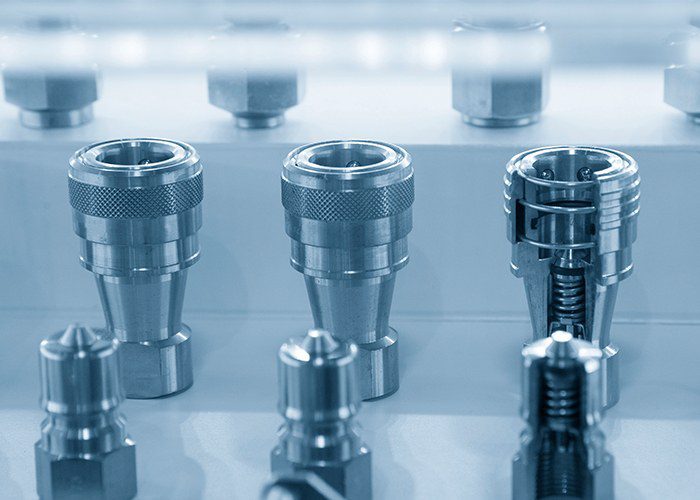
Hydraulic systems operate under pressures that can exceed 5,000 psi or even 10,000 psi in specialized applications. Connectors—such as fittings, adapters, couplings, and nipples—must seal perfectly to prevent fluid leakage, which not only reduces efficiency but also poses safety and environmental hazards. Their geometries often include complex features: tapered threads (NPT, BSPT), straight threads with O-ring grooves (UNF, Metric), flare seats, and internal flow passages. Materials range from carbon steel and stainless steel (304, 316) to brass and specialty alloys, each chosen for corrosion resistance, strength, and compatibility with hydraulic fluids.
Manufacturing these connectors requires micron-level accuracy. A thread pitch deviation of 0.01 mm or a surface roughness above Ra 1.6 μm can lead to galling, leakage, or premature fatigue failure. This is where CNC machining excels.
Why CNC Machining Is Indispensable
CNC (Computer Numerical Control) machining—encompassing CNC turning, milling, and multi-axis live tooling—offers several advantages for hydraulic connector production:
- Tight Tolerances and Repeatability
Modern CNC lathes and machining centers can hold tolerances of ±0.005 mm (±0.0002 inches) on critical diameters and thread forms. Once a program is validated, every part from a batch of thousands is virtually identical. This consistency is essential for connectors that must interchange seamlessly across different system components. - Complex Geometry in One Setup
Many hydraulic connectors require both turning (for external profiles, threads, and faces) and milling (for wrench flats, cross-holes, or hexagons). With live tooling on a CNC Swiss or turn-mill center, manufacturers can complete a connector in a single clamping. This reduces error from repositioning and shortens cycle times. - Wide Material Compatibility
CNC machines readily cut hardened steels, stainless alloys, and even super-duplex materials. Proper toolpath strategies and carbide insert selection ensure efficient metal removal without work hardening or burr formation. For specialty applications like submarine hydraulics, CNC can also machine Inconel or titanium connectors. - Surface Finish Superiority
Hydraulic seals rely on smooth contact surfaces. CNC turning with wiper inserts can achieve Ra 0.4 μm finishes on sealing seats, eliminating the need for secondary grinding. Thread whirling or single-point threading produces clean, burr-free threads that mate perfectly with mating ports. - Automated Quality Assurance
In-process probing systems on CNC machines can measure critical dimensions during production, automatically compensating for tool wear. Combined with post-process vision systems or air gauges, this creates a closed-loop quality environment.
Key Machining Steps for Hydraulic Connectors
A typical CNC process for a hydraulic straight adapter (say, 9/16″-18 UNF male to 7/16″-20 UNF female) might involve:
- Material preparation: Hex bar stock (e.g., 1215 carbon steel or 316 stainless) fed through a CNC Swiss automatic lathe.
- Turning operations: Rough and finish turn the external profile, create the wrench hex, and cut the male thread.
- Drilling and boring: Bore the internal flow passage and counterbore for the O-ring or flare seat.
- Threading: Single-point internal thread for the female port. For high-volume runs, thread rolling on a CNC lathe (using a rolling attachment) yields stronger, cold-worked threads.
- Cross-hole milling: If the connector is a tee or elbow, a second operation on a CNC mill or a dual-spindle lathe performs the cross-drilling.
- Deburring and passivation: Automated brush deburring or thermal deburring removes microscopic burrs, especially from intersecting holes. Stainless parts may undergo passivation for corrosion resistance.
Quality Control Measures
No hydraulic connector is fit for service without rigorous inspection. Reputable CNC shops employ:
- Thread gauges (GO/NO-GO) for every thread size.
- Air gauging for internal diameters in sealing zones.
- Surface profilometers to verify roughness on sealing seats.
- Hydrostatic testing (sample parts) to confirm burst and leak ratings.
- CMM (Coordinate Measuring Machine) for full geometric verification.
Challenges and Solutions
CNC machining of hydraulic connectors is not without obstacles. Small diameters (sometimes under 5 mm) require high spindle speeds and delicate tooling. Long, slender adapters may deflect during turning, causing taper. Solutions include using steady rests, reducing radial forces, or switching to Swiss-type CNC lathes with guide bushings.
Another challenge is thread galling, especially with stainless steel. Applying proper cutting fluids (high-sulfur or EP additives) and using sharp, coated inserts (TiAlN or AlTiN) minimizes friction. Post-machining, anti-galling lubricants may be applied to threads.
The Future: Smart CNC Machining
Industry 4.0 is transforming hydraulic connector manufacturing. CNC machines now incorporate IoT sensors that monitor vibration, temperature, and spindle load. Predictive analytics alert operators to tool wear before a part goes out of spec. Automated robotic tending allows lights-out production, running 24/7. These advances reduce cost while further improving quality.
Conclusion
CNC machining is the backbone of hydraulic connector production. Its ability to deliver precise threads, smooth sealing surfaces, and complex geometries in high-strength materials ensures that hydraulic systems operate safely and efficiently. From a simple cap nut to a multi-port manifold, every CNC-machined connector represents a fusion of engineering skill, advanced software, and rigorous quality control. As hydraulic pressures rise and equipment becomes more compact, the role of precision CNC machining will only grow, continuing to seal the power that moves our world.