In the vast landscape of modern manufacturing, few components are as fundamental—or as demanding—as the machined shaft. From the smallest motor rotor in a medical device to the massive drive shafts of industrial turbines, shafts are the rotating elements that transmit power, torque, and motion across virtually every mechanical system. And at the heart of their production lies CNC (Computer Numerical Control) machining—a technology that has transformed how these critical components are designed, manufactured, and quality-assured.
What Are CNC Machined Shaft Parts?
A shaft is a cylindrical rotating element that transmits power between different parts of a machine—whether it’s a motor, gearbox, pump, or industrial press. Typical shaft parts include drive shafts, transmission shafts, pump shafts, motor rotor shafts, and axle shafts, each carrying specific load requirements, speed ratings, and tolerance bands. What makes CNC machining the preferred manufacturing method for shafts is its ability to produce components with exceptional dimensional accuracy, smooth surface finishes, and consistent material properties throughout their length.
In contrast to manual turning, where operator intervention governs tool movement, CNC turning relies on pre-programmed digital paths to deliver unwavering uniformity across every workpiece in a series. This distinctive repeatability underpins CNC turning’s dominance in shaft manufacturing, with applications ranging from automotive to aerospace.
The Critical Role of Material Selection
The journey of a CNC machined shaft begins not at the machine, but at the materials stage. Material selection is paramount for shaft performance. Shaft materials are selected based on application demands: carbon steels like 1045 and 1050 provide an economical choice for general-purpose use; alloy steels such as 4140 and 4340 deliver enhanced strength and fatigue resistance under heavy loads and high speeds; stainless steels including 304, 316, and 17-4PH ensure corrosion protection in marine, food-processing, and medical environments; titanium (Ti-6Al-4V) offers a lightweight yet high-strength solution for aerospace applications; and aluminum alloys like 6061 and 7075 serve as lightweight options for low-load or high-speed rotating assemblies.
Each material presents unique machining challenges. For instance, 316L stainless steel typically requires a low-speed, high-depth-of-cut process, while 304 is more suitable for high-speed cutting. Titanium alloys are notoriously difficult to machine but are increasingly in demand as aerospace and automotive industries push for lightweight, fuel-efficient designs.
The Manufacturing Process: From Blank to Finished Shaft
The CNC turning process for shaft parts follows a well-established workflow. It begins with design and programming, where engineers use CAD software to create the shaft model with all necessary dimensions, tolerances, and features. This design is then converted into toolpaths using CAM software, generating the G-code that directs the CNC machine’s every movement.
Once the program is ready, round bar stock is cut to length—typically 2–5 mm oversized in diameter to allow for turning removal. Load the blank into the CNC lathe and secure it firmly in the chuck. For longer shafts (typically those with a length-to-diameter ratio above 4:1), a tailstock center provides additional support to prevent deflection during cutting.
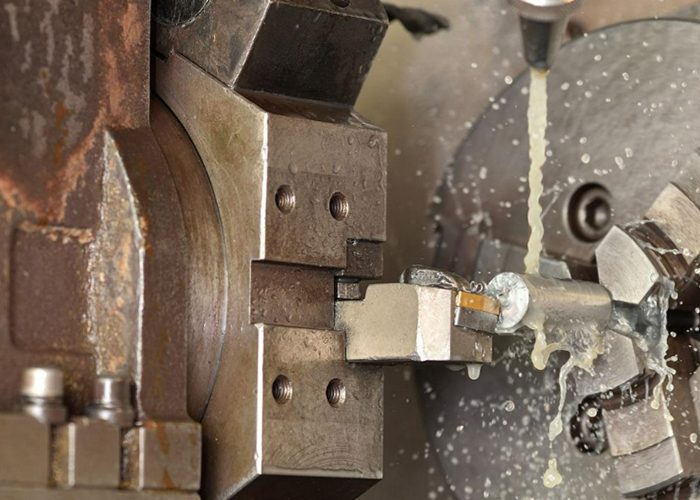
The actual machining proceeds in stages. Roughing passes remove the bulk of the excess material quickly. For a typical 50 mm diameter 1045 steel shaft, roughing might involve a cutting speed of 180–250 m/min, a feed rate of 0.2–0.4 mm/rev, and a depth of cut of 2–3 mm. Finishing passes then bring the shaft to its final dimensions and surface quality.
Tool selection is equally critical. Carbide inserts with appropriate coatings—such as TiN, TiAlN, or AlCrN—are selected based on the workpiece material and cutting parameters. For stainless steel shafts, coated carbide inserts with positive rake angles reduce cutting forces and minimize built-up edge. For hardened alloy steels requiring surface finishes below Ra 0.8 μm, CBN (cubic boron nitride) inserts may be used for finishing passes.
Precision That Defines Performance
The precision achievable through CNC shaft machining is nothing short of remarkable. Standard CNC turning can hold dimensional tolerances within ±0.01 mm. For high-precision applications—hydraulic manifolds, aerospace shafts, or medical implants—tolerances often tighten to ±0.005 mm or even ±0.002 mm on critical diameters. Surface finishes can reach Ra 0.2–0.4 μm, and runout (total indicated runout) can be controlled to ≤ 0.01 mm.
These levels of precision are not merely academic. A shaft that is 0.05 mm oversize won’t fit its bearing bore; a valve spool that is 0.02 mm undersize will leak under pressure. In the world of rotating machinery, these microscopic deviations translate directly into vibration, noise, wear, and premature failure.
Applications Across Industries
CNC machined shaft parts find applications across virtually every sector of modern industry. In the automotive industry, they are used in engines, transmissions, drive systems, and wheel connections. Multi-axis turning technology achieves micron-level (±0.002 mm) roundness control on crankshafts and camshafts, reducing engine vibration and noise while improving power efficiency. Drive shafts benefit from high-rigidity turning solutions that address deformation issues associated with slender shafts, achieving straightness of 0.01 mm per meter.
In aerospace, shafts are used in aircraft and spacecraft for power and motion transmission, ensuring high reliability and precision under extreme operating conditions. The medical industry relies on CNC-turned shafts for surgical instruments, orthopedic implants, and diagnostic equipment, where ultra-high accuracy and compliance with ISO 13485 standards are non-negotiable. Industrial automation and robotics depend on precision shafts for robotic arm joints, couplings, and automation system components.
Quality Control and Industry Standards
Given the critical nature of shaft components, quality control is rigorous and uncompromising. Every custom shaft undergoes comprehensive inspection using calibrated CMMs (Coordinate Measuring Machines), optical comparators, surface roughness testers, and dedicated gauging for critical features like runout and thread accuracy.
Industry standards provide the framework for this precision. ISO 2768 is the most commonly referenced general tolerance standard for machined parts, with classes ranging from “fine” to “very coarse”. For tighter control, IT (International Tolerance) grades from ISO 286 are specified—IT7 is standard for most CNC-turned production runs, while IT6 requires better tooling and rigid setups, and IT5 is typically limited to short runs on high-end Swiss-type lathes. GD&T per ASME Y14.5 adds another layer of precision control, with symbols like cylindricity, circularity, and total indicated runout defining the geometric requirements of the finished part.
The Future of CNC Machined Shafts
The global CNC machined parts market is projected to grow at a CAGR of 6–7% between 2025 and 2030. Key drivers include expanding automotive and aerospace production, increased demand for medical-grade precision components, and the rising adoption of Industry 4.0 technologies. Advanced multi-axis machining is expanding capabilities, enabling manufacturers to handle complex geometries and achieve tolerances as tight as ±0.005 mm. Automation and smart manufacturing—integrating robotics, digital twin simulation, and AI-driven quality inspection—are improving productivity and reducing human error. And as sustainability becomes a standard requirement, eco-friendly machining processes are increasingly the norm.
By 2030, the global CNC machined parts industry is expected to exceed USD 120 billion, with Asia-Pacific remaining the largest production base while North America and Europe continue to dominate in high-end applications and R&D innovation.
Conclusion
CNC machined shaft parts are far more than simple cylinders of metal. They are precision-engineered components that enable the machines of modern industry to function with reliability, efficiency, and safety. From the choice of material to the final quality inspection, every step of the manufacturing process is governed by exacting standards and advanced technology. As industries continue to demand higher performance, lighter weight, and greater precision, CNC machining will remain indispensable—the precision backbone of mechanical engineering.