
In today’s rapidly evolving manufacturing landscape, the demand for components that deviate from standard specifications has grown exponentially. Non-standard parts—custom-designed components that do not conform to conventional size, shape, or material standards—have become indispensable across industries ranging from aerospace to medical devices. At the heart of this specialized production lies CNC lathe machining, a technology that has transformed how manufacturers approach complexity, precision, and customization.
Understanding Non-Standard Parts and the Role of CNC Lathes
Non-standard parts, also known as custom or bespoke components, are engineered to meet specific design or performance requirements that off-the-shelf parts cannot fulfill. These components often feature unique geometries, asymmetrical structures, tight tolerances, or specialized material requirements. CNC (Computer Numerical Control) lathe machining has emerged as the ultimate solution for producing such parts, bridging the gap between complex design concepts and tangible, high-precision products.
Unlike conventional manual lathes, which rely on operator skill and are limited in their ability to produce consistent, repeatable results, CNC lathes operate through computer-controlled programs that execute cutting operations with micron-level accuracy. This program-controlled approach provides stable precision, better consistency, and stronger adaptability for components with threads, grooves, bores, chamfers, and connector features. Modern CNC lathes can achieve positioning accuracy reaching ±0.003mm and repeat positioning accuracy of ±0.005mm, enabling the fabrication of parts with extremely tight tolerances.
Technical Capabilities and Advanced Features
The evolution of CNC lathe technology has dramatically expanded what is possible in non-standard part manufacturing. Today’s advanced turning centers incorporate multi-axis configurations, live tooling, and high-speed automation to produce everything from custom medical implants to mission-critical automotive components.
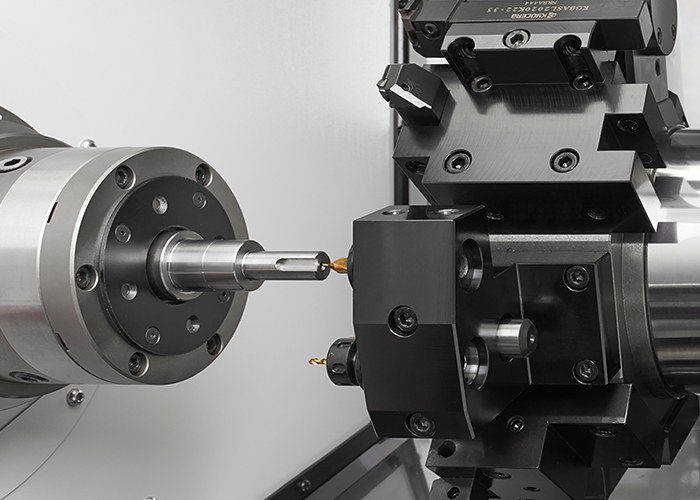
Traditional turning relied on two-axis lathes that removed material while the workpiece rotated—effective for symmetrical, round parts but limited in capability. Modern CNC turning centers now include live tooling that enables drilling, milling, tapping, and engraving on the same setup; rotary positioning allowing precise control over rotational (C-axis) and off-center (Y-axis) movement; and dual turrets and spindles that make it possible to machine both ends of a part simultaneously. This means complex parts with contours, grooves, and asymmetric features can now be created in a single automated process, reducing handling, setup changes, and the risk of positioning errors.
CNC lathes equipped with multi-axis capabilities are specifically designed to handle irregular parts with ease—whether they feature asymmetrical shapes, free-form curves, or complex internal cavities. Specialized turning, milling, and boring operations can be combined in a single setup, reducing the need for multiple machining processes and minimizing errors. Compared to traditional methods, CNC lathes can achieve a higher degree of accuracy, reducing setup-related errors from ±0.015mm to within ±0.005mm, while significantly improving production efficiency by up to 60%.
Materials and Process Workflow
The versatility of CNC lathe machining extends to the wide range of materials it can process. Manufacturers work with diverse materials including stainless steel, aluminum alloys, titanium, copper, brass, carbon steel, engineering plastics, and composites. Each material presents unique machining challenges—aluminum dissipates heat quickly, while titanium’s low thermal conductivity increases tool wear. Skilled CNC programmers use state-of-the-art CAD/CAM software to generate precise toolpaths that conform to complex geometries, with advanced algorithms calculating optimal cutting speeds, feed rates, and tool engagement angles.
The typical process for CNC turning precision non-standard parts begins with drawing design based on product requirements, followed by material preparation, programming using CNC software, machine tool debugging, the actual machining process with real-time monitoring, and final quality inspection including dimension measurement, shape inspection, and surface quality assessment. This systematic approach ensures that every custom component meets the exacting specifications demanded by its intended application.
Applications Across Industries
CNC lathe machining of non-standard parts has become essential across virtually every advanced manufacturing sector. In aerospace, CNC lathes process complex components such as engine blades, turbine discs, and guide blades to meet the high precision, high strength, and high reliability requirements of aerospace products. The automotive industry relies on CNC turning for precision components including engine cylinders, crankshafts, camshafts, fuel injectors, and sensors.
The medical device sector demands components with micron-level precision and exceptional surface finishes—surgical instruments, implants, diagnostic equipment housings, and orthopedic screws are all produced using CNC lathe technology. In electronics, CNC lathes manufacture miniature connectors, precision shafts, non-standard screws and nuts for 3C products, and camera components. Other key industries include robotics, industrial equipment, energy and power generation, military and defense, and mold manufacturing.
Challenges and Solutions
Despite its remarkable capabilities, CNC lathe machining of non-standard parts presents significant challenges. Complex design and programming require tailored approaches for each component, with traditional methods struggling to handle intricate geometries. Ultra-high precision requirements in industries like aerospace and medical devices demand micron-level tolerances, where tool wear, thermal deformation, and material inconsistencies can jeopardize quality. Material diversity—from titanium alloys to carbon fiber composites—requires unique machining strategies for each. Small-batch production, which is common for non-standard parts, can lead to frequent setup changes that increase downtime and costs. Quality control and traceability demand rigorous inspection throughout production.
Manufacturers address these challenges through advanced CAD/CAM software for 3D modeling and simulation, high-precision CNC equipment paired with rigorous quality control systems including CMM (Coordinate Measuring Machines) and laser interferometers. Custom fixture design and adaptive workholding solutions secure irregularly shaped parts during machining. Integration of ERP/MES systems optimizes production scheduling, while predictive maintenance systems reduce tool wear. Multi-stage quality control processes—from raw material inspection to in-process monitoring to final compliance verification—ensure that every part meets specifications.
Future Trends
The future of CNC lathe machining for non-standard parts is being shaped by several transformative trends. Increased automation and robotics are improving efficiency and reducing the risk of errors and inconsistencies. The integration of artificial intelligence and machine learning enables CNC machines to learn from past experiences, optimize cutting speeds and toolpaths in real-time, and enhance overall quality. Customization and personalization continue to grow as manufacturers leverage advanced software to create bespoke parts tailored to individual requirements. Environmental sustainability is becoming a priority, with companies exploring eco-friendly materials, optimizing energy usage, and implementing waste reduction strategies. Remote monitoring and maintenance, enabled by the Internet of Things (IoT), allow manufacturers to monitor and control machines from anywhere, optimizing production schedules and preventing costly downtime.
Conclusion
CNC lathe machining of non-standard parts represents a cornerstone of modern precision manufacturing. By combining advanced multi-axis capabilities, live tooling, sophisticated programming, and rigorous quality control, CNC lathes transform custom design concepts into high-precision, reliable components that drive innovation across industries. As technology continues to evolve—with automation, AI, and sustainability taking center stage—CNC lathe machining will remain at the forefront of manufacturing’s ability to meet the ever-growing demand for customized, high-performance solutions.


