In the relentless pursuit of manufacturing perfection, precision and efficiency are the twin pillars upon which modern industry stands. Among the most transformative technologies driving this evolution is 5-axis CNC machining. While traditional 3-axis machining has served as the backbone of subtractive manufacturing for decades, the advent of 5-axis technology has redefined what is possible. It has moved beyond simple drilling and milling to enable the production of highly complex, intricate, and accurate parts that were once either impossible or prohibitively expensive to create. Understanding the value, mechanics, and applications of 5-axis CNC machining parts is essential for any engineer or procurement specialist looking to stay competitive in fields like aerospace, medical devices, automotive racing, and energy.
What Exactly is 5-Axis Machining?
To grasp the leap forward, one must first understand the basic premise. A standard 3-axis CNC machine operates on three primary linear axes: X (left-right), Y (front-back), and Z (up-down). The cutting tool approaches the workpiece from a fixed, vertical orientation. While effective for simple prismatic parts, this setup has severe limitations when dealing with undercuts, deep cavities, or complex freeform surfaces. The operator must manually reposition the workpiece multiple times, leading to increased setup time, alignment errors, and geometric inaccuracies.
5-axis CNC machining adds two additional rotational axes to the existing three linear movements. Typically, these are the A-axis (rotation around the X-axis) and the B-axis (rotation around the Y-axis), or a combination of a trunnion table and a rotary axis. This allows the cutting tool to approach the workpiece from virtually any direction in a continuous, synchronized motion. In essence, the part can be flipped, tilted, and rotated while the spindle simultaneously moves in three linear directions. This five degrees of freedom unlocks an unprecedented level of geometric complexity.
The Unmatched Advantages of 5-Axis Machined Parts
Why invest in a 5-axis system when a 3-axis machine is cheaper and simpler? The answer lies in a cascade of tangible benefits that directly impact the quality, cost, and lead time of machined parts.
1. Complex Geometries in a Single Setup: The most significant advantage is the ability to machine highly complex parts in a single clamping operation. Consider an impeller for a jet engine or a hip implant with curved, organic surfaces. A 3-axis machine would require four or five separate setups, each introducing potential misalignment and tolerance stack-up. With 5-axis, the part is mounted once, and the machine does the rest. This eliminates human error, dramatically improves accuracy, and reduces cycle time.
2. Superior Surface Finishes: Because the tool can be tilted to maintain an optimal, constant cutting edge contact with the workpiece, 5-axis machining produces far superior surface finishes. In 3-axis machining, the tip of a ball-nose end mill is often used to cut complex contours, leaving a poor “step-over” pattern that requires secondary polishing. With 5-axis, the tool is angled to use the side of the cutter, resulting in smoother surfaces that often eliminate the need for post-processing.
3. The Use of Shorter, Stiffer Cutting Tools: This is a subtle but critical advantage. When machining deep cavities or vertical walls, a 3-axis machine relies on long, extended tools that are prone to chatter, deflection, and breakage. The 5-axis capability allows the operator to tilt the tool or the table, bringing the cutter head closer to the cutting zone. This allows the use of shorter, larger-diameter tools with reduced overhang, resulting in higher stiffness, faster material removal rates, and superior part accuracy.
4. Reduced Lead Times and Lower Costs: While the hourly rate of a 5-axis machine is higher than that of a 3-axis, the total cost per part is often significantly lower. By eliminating multiple setups, reducing the need for custom fixtures, minimizing manual labor, and slashing scrap rates, 5-axis machining delivers a lower cost-per-part for complex components. Less human intervention also means less opportunity for costly mistakes.
Critical Applications Across Industries
The unique properties of 5-axis CNC machining parts make them indispensable in sectors where failure is not an option.
- Aerospace: Turbine blades, structural housings, airframe components, and fuel system manifolds. These parts require complex aerodynamic surfaces, deep pockets, and extreme lightweight properties, all machined from tough alloys like Inconel, Titanium, and Stainless Steel. The 5-axis capability ensures continuous chip load and reduced tool wear on these difficult-to-machine materials.
- Medical: Orthopedic implants (knees, hips, spinal screws), surgical guides, and dental prosthetics. These parts are often patient-specific, featuring organic, freeform surfaces that must be perfectly biocompatible. 5-axis machining can produce a bone screw or a custom cranial plate from a titanium billet in a single, flawless operation.
- Automotive & Motorsports: Cylinder heads, intake manifolds, suspension components, and mold tooling for body panels. Performance parts demand intricate internal channels for fluid dynamics and lightweight lattice structures.
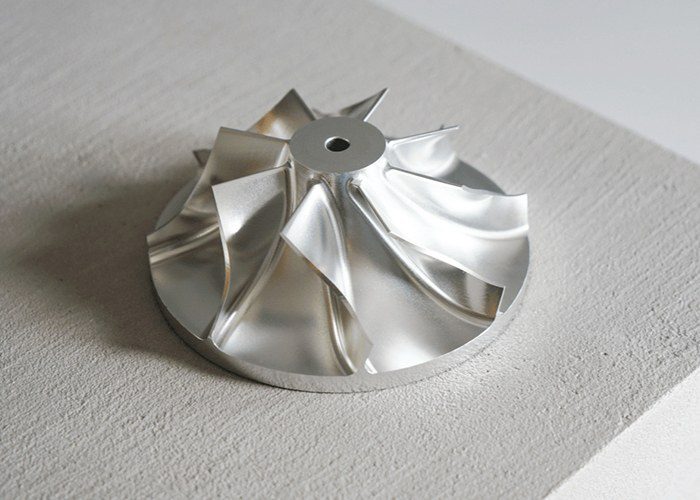
- Energy: Impellers for turbochargers, compressors, and hydraulic turbines. These parts rely on precise blade geometry for thermodynamic efficiency, which is only achievable with simultaneous 5-axis contouring.
Considerations and The Future
Despite its power, 5-axis machining is not a panacea. It requires highly skilled programmers who understand advanced CAM (Computer-Aided Manufacturing) toolpath strategies, such as “tool axis tilting” to avoid collisions. The machines themselves are a significant capital investment, and post-processors must be meticulously configured. However, the trend is clear. As designs become more complex and the demand for lighter, stronger, more efficient parts increases, the reliance on 3-axis machining will continue to wane.
The future is already integrating 5-axis with additive manufacturing (hybrid machines) and AI-driven adaptive machining. For now, the 5-axis CNC machined part represents the gold standard of precision manufacturing. It is a testament to how far we have come from manual mills and lathes—a technology that does not just cut metal but sculpts the future, one micron at a time. Whether it is a life-saving medical implant or a turbine spinning at 50,000 RPM, the quiet, precise dance of the 5-axis machine is what makes the modern world possible.