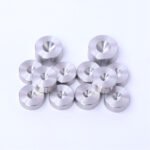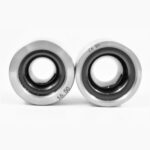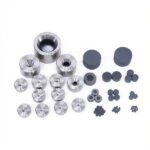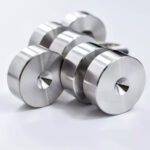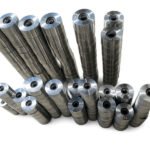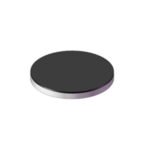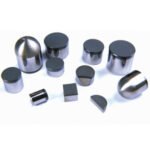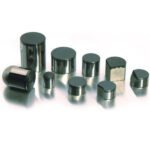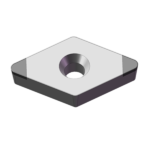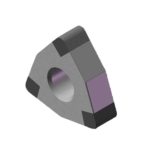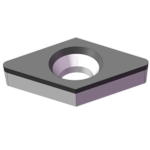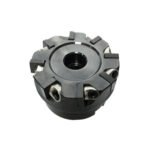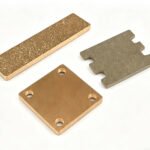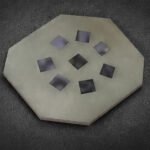

A tool manufacturer in Michigan specs a PCD blank for a hardened steel gear job — HRC 58, 800 RPM, flood coolant. Within 200 parts, the cutting edge is gone. Not from abrasion, not from poor geometry, but from a chemical reaction between diamond carbon and iron at 700°C. The blank wasn’t defective. The material was wrong. The scrapped gears and replacement tooling cost $14,000 — and the customer found another supplier.
The PCD vs PCBN decision isn’t about which material is “better.” It’s about chemistry. Diamond reacts with iron at cutting temperatures, and no edge geometry fixes that. The PCD vs CVD question adds another dimension — sintered composite versus binderless single crystal, each built for fundamentally different jobs. Get the material wrong, and you’ve wasted a blank, scrapped parts, and lost a customer’s trust. This guide breaks down all three superhard blank materials so you never spec the wrong one again.
The Three Superhard Blank Materials: What Makes Them Different
Three materials dominate the superhard cutting tool blank market, and they differ in ways that matter more than a spec sheet suggests.
PCD (polycrystalline diamond) is a sintered composite: diamond particles fused with a cobalt binder onto a tungsten carbide substrate at extreme pressure and temperature through the HPHT process. Hardness reaches 7,500–10,000 HV — five to six times carbide. The cobalt binder gives PCD its fracture toughness and makes it EDM-cuttable and regrindable, properties no other superhard material matches.
PCBN (polycrystalline cubic boron nitride) uses the same HPHT sintering concept but swaps diamond for CBN grains, bonded with ceramic or metallic binders onto a carbide substrate. Hardness drops to 3,000–5,000 HV — still twice carbide — but the critical difference is chemical: CBN is inert to iron at temperatures up to 1,400°C. That single property is why the PCD vs PCBN divide exists.
CVD diamond takes a different path. No binder, no substrate sintering. Pure diamond deposited as a thick film through chemical vapor deposition, reaching ~10,000 HV with edge sharpness that sintered PCD cannot achieve. Structurally, PCD and CVD are opposites — CVD’s lack of binder means no cobalt to limit edge quality, but also no toughness to resist fracture.
What actually separates them? Not hardness. Chemical affinity and thermal stability — because the wrong chemistry destroys an edge faster than any abrasive.
Why PCD Can’t Cut Steel (The Carbon-Iron Reaction)
At cutting temperatures above 700°C, diamond’s carbon atoms dissolve into iron. This isn’t gradual wear — it’s a chemical phase transformation. The iron acts as a solvent, pulling carbon out of the diamond lattice. The edge doesn’t dull; it disintegrates.
This is why the PCD vs PCBN line is absolute, not a matter of degree. PCD works on aluminum, copper, composites, and wood — anything non-ferrous. The moment your workpiece contains iron above ~45 HRC, PCD is the wrong material, and no grain size, coating, or cutting parameter changes that. CBN exists for exactly this reason — to cut what diamond chemically cannot.
PCD vs PCBN vs CVD: Quick Comparison Matrix
The fundamental PCD vs PCBN difference comes down to chemistry: diamond reacts with iron at cutting temperatures, while CBN does not. On the Vickers scale, PCD reaches 7,500–10,000 HV, PCBN measures 3,000–5,000 HV, and CVD diamond approaches 10,000 HV — all far exceeding carbide’s 1,500–1,800 HV. Use this matrix to match your workpiece material to the right superhard blank:
| Property | PCD | PCBN | CVD Diamond |
| Hardness (HV) | 7,500–10,000 | 3,000–5,000 | ~10,000 |
| Thermal stability | ~700°C | ~1,400°C | ~700°C |
| Chemical affinity | Reacts with iron (>700°C) | Inert to iron | Reacts with iron (same as PCD) |
| Structure | Diamond + cobalt binder + WC substrate (HPHT) | CBN + ceramic/metal binder + WC substrate (HPHT) | Pure diamond film (CVD, no binder) |
| Best for | Non-ferrous: aluminum, copper, CFRP, wood, graphite | Hardened steel (>45 HRC), cast iron, superalloys | Ultra-precision: optics, graphite, ceramics |
| Do NOT use on | Steel, cast iron, ferrous alloys | Soft steel (<45 HRC), non-ferrous | Interrupted cuts, ferrous materials |
| Regrindable? | ✅ Yes (EDM, laser, diamond wheel) | ✅ Yes | ❌ No (coated); limited (thick-film) |
| Relative cost | Medium | Medium–High | Highest |
Selection rule: Ferrous material → PCBN. Non-ferrous material → PCD. Ultra-precision mirror finish (Ra < 0.05 μm) → CVD. When uncertain, start with PCD — it covers ~80% of non-ferrous applications at the lowest cost.
For specific diameters, grain sizes, and substrate options, browse our PCD blank specifications and request a free sample to test on your workpiece.
When to Choose PCD Blanks
PCD blanks own non-ferrous machining for one reason: 50–250× longer tool life than carbide on aluminum, copper, composites, and wood — at cutting speeds up to 2,500 m/min. That’s why PCD is the default blank for automotive aluminum components, aerospace CFRP trimming, PCB routing, and woodworking profile tools. Tool manufacturers then process these blanks into finished PCD inserts for specific cutting applications.
PCD’s advantages go beyond tool life. The cobalt-bonded structure is regrindable — resharpen a blank multiple times via EDM, laser, or diamond grinding, extending its economic life well beyond the first edge. Thermal conductivity up to 2,000 W/m·K keeps cutting-zone temperatures low, preventing resin softening in composites and built-up edge in aluminum. In our experience at Uking Diamond, shops that switch from carbide to PCD on aluminum rarely switch back — the tool life difference is too dramatic to ignore.
But PCD has one absolute limit: no ferrous materials. Not mild steel, not hardened steel, not cast iron. Thermal stability caps at ~700°C, ruling out high-temperature alloys. On non-ferrous jobs, PCD wins decisively on both performance and cost.
For the complete specification framework — diameters, layer thicknesses, substrate options — see our complete PCD cutting tool blank buyer’s guide. For matching 1 μm to 25 μm grades to specific workpiece materials, our PCD blank grain size selection guide walks through the details.
PCD vs PCBN: When PCBN Blanks Are Required
Uking Diamond does not manufacture PCBN blanks; the following information is provided for material selection reference only.
If your workpiece is ferrous and hard — above 45 HRC — PCBN is the correct blank material, full stop. The PCD vs PCBN dividing line is the periodic table: iron-bearing materials go to PCBN, everything else goes to PCD. No exceptions.
PCBN earns its keep on four material families: hardened steel (HRC 45–65) for automotive gears, bearings, and camshafts; gray and ductile cast iron for brake discs and cylinder liners; powder metallurgy parts like valve seats; and nickel-based superalloys for turbine components.
A PCBN cutting tool blank’s real strength is hard turning — replacing grinding with single-point turning that achieves Ra 0.4 μm or better. Take a German automotive tier supplier running hardened gear shafts at HRC 60. Grinding took 8 minutes per shaft. PCBN hard turning cut that to 5 minutes, a 35% cycle time reduction, while holding tighter dimensional consistency across the batch. Three years later, they haven’t gone back to grinding. For operations like this, PCBN’s thermal stability (up to 1,400°C, per published research on PCBN thermal stability) means it survives cutting-zone temperatures that would destroy PCD in seconds.
Limitations: PCBN costs more than PCD due to CBN raw material pricing. It demands rigid machine setups — chatter destroys PCBN edges fast. And for soft materials below 45 HRC, PCBN is both unnecessary and uneconomical. On cost alone, PCBN wins only where PCD chemically cannot work.
When to Choose CVD Diamond Blanks
Uking Diamond does not manufacture CVD blanks; the following information is provided for material selection reference only.
CVD diamond has one job: ultra-precision machining where the surface finish is the product. Optical lens molds requiring Ra < 0.02 μm, precision graphite electrodes, ceramic and sapphire components, jewelry and watch parts — these are the applications where CVD’s binderless pure diamond produces edges measured in nanometers. At ~10,000 HV, CVD matches the theoretical maximum for diamond, well-documented across polycrystalline diamond engineering applications. With no metallic binder, there’s no cobalt to degrade at high temperatures or catalyze graphitization. The edge is the sharpest achievable in commercial cutting tool materials.
An optics mold shop in Switzerland ran into a wall with fine-grain PCD on stainless steel lens molds for medical optics — visible grain-boundary marks left the surface at Ra 0.04 μm, but their customer demanded Ra 0.02 μm. They switched to CVD and hit Ra 0.015 μm on the first batch.
But CVD is brittle. Interrupted cuts, even minor vibration, or any ferrous workpiece will destroy the edge. Coated CVD variants cannot be reground — once the edge is gone, the tool is done. Thick-film CVD offers limited regrinding but at the highest cost per blank of the three materials.
Decision Guide: Which Blank for Your Job?
Three rules cover 95% of blank selection:
- Workpiece contains iron (steel, cast iron, HRC >45) → PCBN. The carbon-iron reaction makes PCD impossible, and CVD has the same chemical limitation. This is the one case where the PCD vs PCBN question has a single correct answer.
- Workpiece is non-ferrous (aluminum, copper, composites, wood, graphite) → PCD. Best hardness-to-cost ratio, regrindable, proven across millions of production cycles.
- Surface finish spec demands Ra < 0.05 μm (optics, precision molds) → CVD. Only binderless diamond achieves true mirror finishes.
The gray zone: stacked materials. CFRP-aluminum laminate — common in aerospace — seems to split the difference, but PCD is the answer. The aluminum layer makes PCBN uneconomical, and PCD handles both the composite and aluminum in a single pass. For mixed-material stack-ups, PCD is the pragmatic default.
Before finalizing your spec, review the 5 red flags in PCD blank suppliers to ensure your sourcing partner delivers consistent quality batch after batch.
Frequently Asked Questions
Can PCD blanks be used for machining steel?
No, PCD cannot cut steel. Above 700°C, diamond carbon atoms dissolve into iron, causing rapid chemical wear that destroys the edge. This is a fundamental chemical limitation, not a performance gap. For all ferrous materials — hardened steel, cast iron, powder metallurgy — a PCBN cutting tool blank is the correct choice.
What is the difference between PCD and CVD diamond?
PCD is sintered diamond with a cobalt binder — tougher, regrindable, and suited to high-volume non-ferrous machining. CVD is pure binderless diamond deposited as a film — harder, sharper, but brittle and typically not regrindable. The PCD vs CVD choice depends on whether you need toughness (PCD) or extreme edge sharpness (CVD).
Is PCBN harder than PCD?
No, PCBN is not harder than PCD. PCD measures 7,500–10,000 HV; PCBN measures 3,000–5,000 HV. PCBN’s advantage isn’t hardness — it’s chemical inertness to iron. A PCBN cutting tool blank survives ferrous machining not because it’s harder than PCD, but because it doesn’t react with the workpiece.
Which is more expensive: PCD, PCBN, or CVD?
CVD single crystal is typically the most expensive, followed by PCBN. PCD is the most cost-effective for high-volume non-ferrous machining, since HPHT sintering is a mature, scalable process. When weighing PCD vs PCBN on cost alone, PCBN’s higher price reflects CBN raw material costs — but for ferrous jobs, there’s no cheaper alternative that actually works.
Can I use one blank material for everything?
No. PCD handles roughly 80% of non-ferrous jobs, but ferrous machining requires PCBN and ultra-precision work requires CVD. Forcing one material across all workpieces is the most common — and most expensive — selection mistake in superhard tooling. No single material covers all applications — and anyone who tells you otherwise is selling something. See our complete PCD cutting tool blank buyer’s guide for specification details.
Three Materials, Three Jobs — Pick the Right One
Three materials, three jobs. PCD is the non-ferrous workhorse — hardest, most cost-effective, regrindable, covering 80% of non-ferrous applications. PCBN is the ferrous specialist — chemically inert to iron, thermally stable to 1,400°C, the only viable choice for hardened steel and cast iron. CVD is the precision extreme — pure diamond, nanometer-scale edges, reserved for applications where surface finish is the product.
Uking Diamond specializes in PCD cutting tool blanks. We don’t make PCBN or CVD — and that’s exactly why we can give you an honest comparison, whether you’re weighing PCD vs PCBN for a mixed-material line or PCD vs CVD for a precision mold job. If your application calls for PCD, request a free sample with no minimum order. Test the exact grade and diameter on your workpiece before committing to volume.
PCD cutting tool blanks with no MOQ →
- Email: [email protected]
- WhatsApp: +8613126851888