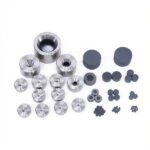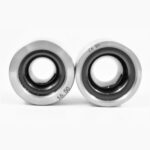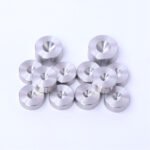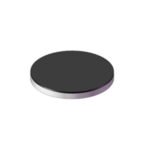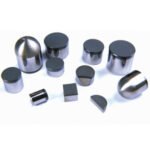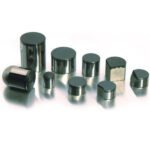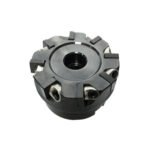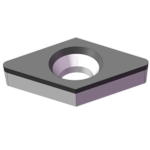

Most tool manufacturers don’t leave a bad PCD blank supplier all at once. They leave slowly — one delayed batch, one inconsistent bond, one oversized MOQ that locks up capital for a quarter. By the time the damage surfaces in your scrap rate or a customer’s complaint log, the cost has already compounded.
You stick with the same supplier not because the quality still impresses you, but because switching feels riskier than staying. That instinct is natural — and it’s exactly what lets hidden costs accumulate, batch after batch. If you’re wondering how to evaluate PCD supplier reliability, the five signs below are a practical starting point. For broader context, see our complete buyer’s guide to PCD cutting tool blanks.
The five red flags to watch for in a PCD blank supplier:
- No bond integrity testing documentation — missing C-SCAN reports
- Minimum order requirements that freeze capital — MOQ traps blocking innovation
- Grain size inconsistency across batches — tool life variance ±15%+
- Opaque lead times with no transparency — vague “4–6 weeks” with no schedule
- No ability to customize or support special geometries — resellers not manufacturers
Why PCD Blank Supplier Quality Matters More Than Price
PCD tools achieve 50–250× longer tool life than carbide in non-ferrous machining — but only when the underlying blank is sound. With hardness ratings of 7,500–10,000 HV, polycrystalline diamond is the hardest cutting material in commercial use. A supplier who cuts corners on sintering pressure, bond integrity, or grain consistency sells you a cheaper disc — and a more expensive operation.
The math is brutal in its simplicity. A blank priced 10% lower can translate to 30%+ higher total cost if tool life drops proportionally. That’s before you count scrap from premature edge failure, machine downtime during tool changes, and the reputational damage when a delaminating insert fails on your customer’s CNC line.
What separates a reliable PCD blank manufacturer from a liability isn’t the unit price on a quote — it’s what happens when something goes wrong. The five signs below help you tell the difference before a crisis forces the question.
Sign #1 — No Bond Integrity Testing Documentation
The bond between the PCD layer and the tungsten carbide substrate is the structural backbone of every blank. When that bond is weak, the PCD layer separates during cutting — a failure mode called delamination, and the number-one cause of PCD insert failure in field conditions.
A serious polycrystalline diamond blank supplier tests every batch. The industry standard is ultrasonic C-SCAN, a non-destructive method that maps the bond interface and flags voids or weak adhesion zones. If your supplier can’t produce a C-SCAN report on request, they’re either skipping the test or not keeping records. Both are unacceptable. At Uking Diamond, C-SCAN verification is standard on every batch — no surcharges, no special requests needed.
When a tool delaminates on your customer’s machine, the failure traces back to you — not the blank supplier. You absorb the warranty claim, the rework, and the damaged relationship.
How to test your supplier: Ask directly — “Do you provide ultrasonic C-SCAN reports for each batch?” If the answer is vague, conditional, or requires a special request, that’s your first red flag.
Sign #2 — Why Your PCD Blank Supplier’s MOQ Requirements Freeze Your Capital
This is where most tool shops feel the pain but rarely trace it back to the supplier. Traditional PCD blank suppliers often require minimum orders of 100 to 500 discs per batch — sometimes more. For a large operation running high-volume standard specs, that’s manageable. For everyone else, it’s a trap.
Consider a ten-person tool shop we worked with last year. They needed to test a new PCD grade for an aerospace aluminum contract — 20 discs would have covered the trial. Their existing supplier’s MOQ was 200 pieces. Unable to justify the inventory but unwilling to abandon the spec, they ordered the full quantity, tying up roughly six months of blank stock. Two months later, a major production expansion opportunity came up. The capital was gone. They missed the window.
For R&D teams and custom tool manufacturers, MOQ blocks innovation — new geometries, untested grain sizes, and prototype specs all require small-batch validation before commitment. A supplier who refuses single-digit quantities is telling you their business model matters more than yours.
Need to test a single spec before committing? PCD cutting tool blanks with no minimum order — request a quote for exactly the quantity you need, from one disc to full production runs.
Sign #3 — Grain Size Inconsistency Across Batches
You order the same spec every time. But tool life swings 20% or more between batches, and nobody on your floor can explain why. That’s grain size inconsistency — one of the most common and costly problems with lower-tier PCD cutting tool blank suppliers.
The root cause is usually one of two things. Either raw diamond powder lots are getting mixed across batches, or sintering parameters — temperature, pressure, cycle time — are drifting without tight process control. Mixed powder or drifting sintering — either way, your next batch won’t match your last. Edge wear patterns shift. Surface finish on the workpiece varies. Your customer doesn’t care that your supplier had a bad powder lot. They care that their surface finish went from Ra 0.4 to Ra 0.8 overnight. Research on PCD tool wear mechanisms confirms that grain size variation directly impacts intergranular and cleavage fracture patterns, causing unpredictable tool life (Jiang et al., Wear, 2024).
Track tool life data per batch. If you see ±15% variance on the same spec under identical cutting conditions, start asking questions. A supplier worth keeping provides grain size certification per batch and SEM imaging on request. For guidance on matching grain size to your specific application, see our PCD blank grain size selection guide. Choosing the right grade is step one; getting it consistently is what separates a supplier from a partner.
Sign #4 — When Your PCD Blank Supplier Won’t Commit to a Lead Time
“Four to six weeks” is the standard answer. What it usually means is: we have no idea, and we’ll tell you when it ships.
For a tool manufacturer, vague lead times are a planning nightmare. You can’t schedule production or commit delivery dates to your customers. When you’re forced into emergency air freight, the cost eats your margin alive.
A transparent PCD cutting tool blank supplier communicates differently. They tell you the current production batch, provide a realistic ship date backed by an actual schedule, and flag potential delays before they become emergencies. If a spec is in stock, they say so. If it isn’t, they tell you when it will be — not when they hope it might be.
Test this during the quoting stage. Ask: “What’s your current production lead time, and can you share a production schedule?” The quality of the answer tells you everything. A supplier who gives you a specific date with context is managing production. One who gives you a range with no detail is managing your expectations.
Sign #5 — No Ability to Customize or Support Special Geometries
Standard round blanks in standard sizes are easy. Any supplier can source those — including trading companies that have never operated a sintering press.
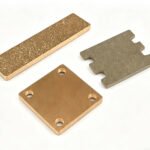
A real manufacturer produces non-standard geometries — irregular shapes, special diameters, double-layer thicknesses, edge preps, custom orientations. High-end tool customers request these specs more frequently every year, and if your supplier can’t deliver, neither can you. The same HPHT manufacturing capability also produces PCD wire drawing dies for precision wire processing — another product where supplier manufacturing depth matters.
When a supplier says “we only carry standard sizes” or “custom takes too long,” they don’t own the manufacturing floor. They’re reselling someone else’s catalog, and your flexibility is limited to whatever that catalog contains. Ask about wire electrical discharge machining (EDM) and laser cutting capabilities, minimum custom batch sizes, and sample turnaround times. A real manufacturer answers in specifics.
How to Switch Suppliers Without Disrupting Production
Switching PCD blank suppliers follows a four-step parallel testing process that minimizes production risk and avoids disruption — run the new material alongside your existing supply and compare real-world performance before committing volume:
- Request free samples from the new supplier for your most critical specs. Test them in parallel with your current stock.
- Run side-by-side comparisons on non-critical jobs first. Track tool life, surface finish, and any edge chipping or delamination.
- Gradually shift volume once quality is validated. Start with 20–30% of your orders, then scale up as confidence builds.
- Maintain buffer stock from your old supplier during the transition — typically one to two production cycles’ worth.
Step one costs you nothing. Uking Diamond offers free sample testing with no minimum order — so you can evaluate our blanks against your exact cutting conditions, with zero commitment and zero risk.
Frequently Asked Questions
What certifications should a PCD blank supplier provide?
A reputable supplier provides batch-level grain size certification, ultrasonic C-SCAN bond integrity reports, and material composition data — anything less is a red flag. ISO 9001 quality management certification is a baseline expectation. If a supplier can’t produce these on request, walk away — no negotiation needed. If the supplier serves aerospace or automotive tool manufacturers, they may also hold IATF 16949 (automotive quality) or AS9100 (aerospace quality) certifications.
How do I test PCD blank bond integrity without specialized equipment?
If you don’t have a C-SCAN system, run a practical field test: cut a blank to size and subject it to aggressive thermal cycling during diamond grinding. Weak bonds will delaminate or show edge lifting under thermal stress. You can also press a hardened steel probe against the PCD-carbide interface — any movement or separation indicates poor adhesion. For production-grade verification, always request the supplier’s C-SCAN report.
Can I order a small quantity to evaluate a new PCD blank supplier?
Yes — and you should. Any supplier worth evaluating accommodates sample or trial orders without forcing you into large minimum quantities. At Uking Diamond, there is no MOQ. You can order a single disc for testing, validate the performance, and scale up only when you’re satisfied. If a supplier refuses small orders, they’re prioritizing their convenience over your evaluation process.
How long does a supplier evaluation typically take?
A thorough evaluation runs four to eight weeks — sample procurement (1–2 weeks), parallel cutting tests on your production line (2–3 weeks), and data analysis comparing tool life, surface finish, and consistency (1–2 weeks). Factor in an extra cycle if you’re testing multiple grain sizes or geometries. Rushing the evaluation is the most common mistake we see — let the data drive your decision, not the calendar.
If your current PCD blank supplier shows even two of these five signs, the hidden costs are already compounding — in scrap, in downtime, in capital you can’t deploy, and in customers slowly losing confidence.
Switching doesn’t require a leap of faith. Uking Diamond ships free samples with no minimum order — evaluate against your exact specs, zero commitment. Request your PCD blank sample → Switch when you’re ready. Not when a crisis forces you.