
In the ever-evolving landscape of modern manufacturing, precision, speed, and versatility are not merely desirable traits—they are absolute necessities. Among the most transformative innovations of the past few decades is the integration of two fundamental machining processes: turning and milling. When combined under the umbrella of Computer Numerical Control (CNC), CNC Turning Milling (often referred to as mill-turn or turn-mill machining) has emerged as a cornerstone technology for producing complex, high-tolerance components. This article explores the principles, advantages, applications, and future potential of CNC turning-milling centers.
Understanding the Two Pillars: Turning and Milling
To appreciate the synergy of turning and milling, one must first understand each process individually.
CNC Turning involves rotating a workpiece on a spindle while a stationary cutting tool moves linearly to remove material. Traditionally performed on lathes, turning is ideal for creating cylindrical parts—shafts, bushings, discs, and rings. The primary motion comes from the workpiece’s rotation, allowing for symmetric features like diameters, tapers, threads, and grooves.
CNC Milling, by contrast, rotates a multi-tooth cutting tool while the workpiece remains clamped on a moving table. Milling excels at creating flat surfaces, slots, pockets, and complex 3D contours. It offers greater geometric freedom because the tool can move along multiple axes (typically X, Y, and Z).
For decades, manufacturers were forced to choose between these two processes, often requiring separate machines and multiple setups to complete a part that needed both cylindrical and prismatic features. This separation introduced inefficiencies: cumulative tolerances, idle time, and labor costs.
The Birth of Turn-Mill Machines
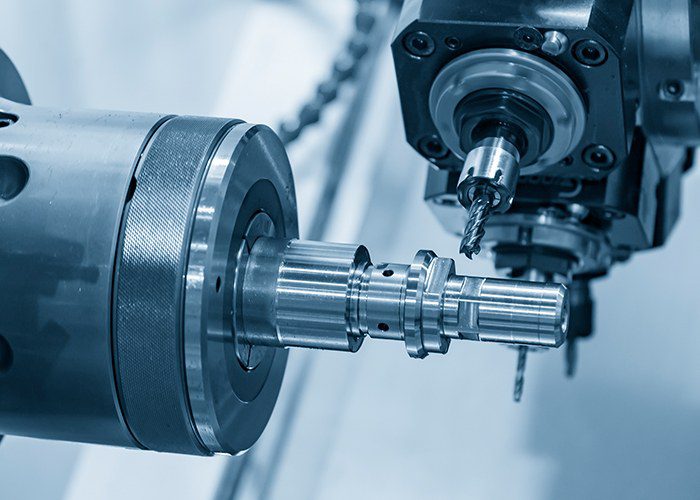
CNC turning-milling machines break down this barrier by integrating both capabilities into a single, highly sophisticated platform. A typical mill-turn machine is built upon a lathe-like structure but incorporates a live tooling system—rotating tools that can be engaged while the workpiece is held stationary or rotating slowly. Additionally, many turn-mill centers feature a second spindle (sub-spindle) and a Y-axis, enabling full simultaneous 5-axis machining.
The core concept is done-in-one manufacturing: a raw bar stock enters the machine, and a finished part exits, often without any human intervention between operations.
Key Advantages of CNC Turning Milling
The adoption of mill-turn technology is not a mere incremental improvement; it is a paradigm shift. The benefits are substantial:
1. Reduced Setup Time and Lead Time
In conventional manufacturing, a part requiring turning and milling might move from a CNC lathe to a CNC mill, each requiring separate fixturing, tool setting, and program loading. With turn-mill, all operations occur in one clamping. Setup time can be reduced by 50–70%, and overall lead time shrinks dramatically.
2. Superior Accuracy and Tolerance Control
Every time a part is unclamped and re-fixtured on another machine, errors accumulate—datum shifts, angular misalignments, and clamping distortions. By completing all features in one setup, turn-mill eliminates these “soft jaw” errors. Concentricity between a turned diameter and a milled flat becomes inherently more precise, often achieving tolerances of ±0.005 mm or better.
3. Reduced Work-in-Process and Floor Space
Fewer machines and fewer part transfers mean less inventory sitting between operations. A single turn-mill center can replace a lathe, a mill, a grinder, and various manual benches. For job shops and high-volume producers alike, this condenses the production line and frees up valuable shop floor space.
4. Complex Geometries Made Simple
Certain parts—such as camshafts, turbine blades, medical bone screws, and hydraulic valve bodies—combine rotational symmetry with off-axis holes, keyways, flats, and undercuts. Mill-turn machines with C-axis (controllable spindle positioning) and Y-axis (off-center milling) can produce these features in a fraction of the time required by traditional methods.
5. Improved Surface Finish and Tool Life
Because the part remains in a stable, rigid clamping environment, vibrations are minimized. Moreover, modern turn-mill centers support high-pressure coolant and advanced toolpath strategies (e.g., trochoidal milling, high-feed turning), which enhance chip evacuation and reduce thermal damage to both the part and the cutting tool.
Real-World Applications
The versatility of CNC turning milling has made it indispensable across numerous industries.
- Aerospace: Components like landing gear actuators, engine housings, and fuel system fittings demand both cylindrical precision and complex milled pockets. Turn-mill machines produce these in exotic alloys (Inconel, titanium) with tight tolerances for safety-critical assemblies.
- Automotive: Turbocharger rotors, drive shafts, and transmission components benefit from the reduced cycle times. High-volume producers use multi-spindle turn-mill centers to output thousands of parts per day with consistent quality.
- Medical: Bone screws, spinal implants, and surgical instruments often require fine threads, cross-holes, and contoured surfaces. The ability to machine these from biocompatible stainless steel or titanium in one setup ensures sterility and precision.
- Oil & Gas and Hydraulics: Valve bodies, connectors, and pump shafts feature deep bores, cross-drilled passages, and sealing surfaces. Turn-mill technology delivers the necessary surface integrity and leak-proof geometries.
Considerations and Challenges
Despite its many strengths, CNC turning milling is not a universal panacea. The initial capital investment for a mill-turn machine is significantly higher than that for a standalone lathe or mill. Additionally, programming such machines demands advanced CAM (Computer-Aided Manufacturing) skills, especially when synchronizing multiple spindles and live tools. Tooling costs can also escalate because live toolholders are more expensive than static ones.
Furthermore, part geometry dictates feasibility. Very long, slender shafts may still require dedicated turning centers with steady rests, while large prismatic boxes are better suited to horizontal milling machines. The savvy manufacturer must perform a cost-benefit analysis for each component family.
The Future: Automation and Digital Integration
The trajectory of CNC turning milling points toward ever-greater autonomy. Already, many machines are equipped with robotic loaders, part conveyors, and in-process gauging. With Industry 4.0, these machines communicate with enterprise software to adjust feeds, speeds, and tool changes based on real-time data. Artificial intelligence algorithms are beginning to predict tool wear and optimize cutting parameters automatically.
Hybrid machines that add additive manufacturing (laser metal deposition) to turn-mill capabilities are also emerging, allowing for repair of high-value components or creation of complex internal lattices.
Conclusion
CNC turning milling represents a mature but still-evolving synthesis of two foundational machining processes. By uniting the rotational efficiency of turning with the geometric freedom of milling, it delivers unparalleled accuracy, speed, and simplicity. For any manufacturer facing the challenge of producing intricate, round parts with off-axis features, a mill-turn center is not just a tool—it is a strategic advantage. As digital technologies continue to advance, the line between turning and milling will blur further, giving rise to truly universal machining centers that redefine what is possible in subtractive manufacturing.
In an age where time is money and precision is paramount, CNC turning milling stands as a testament to engineering ingenuity—a technology that does more with one setup, one program, and one vision.


