
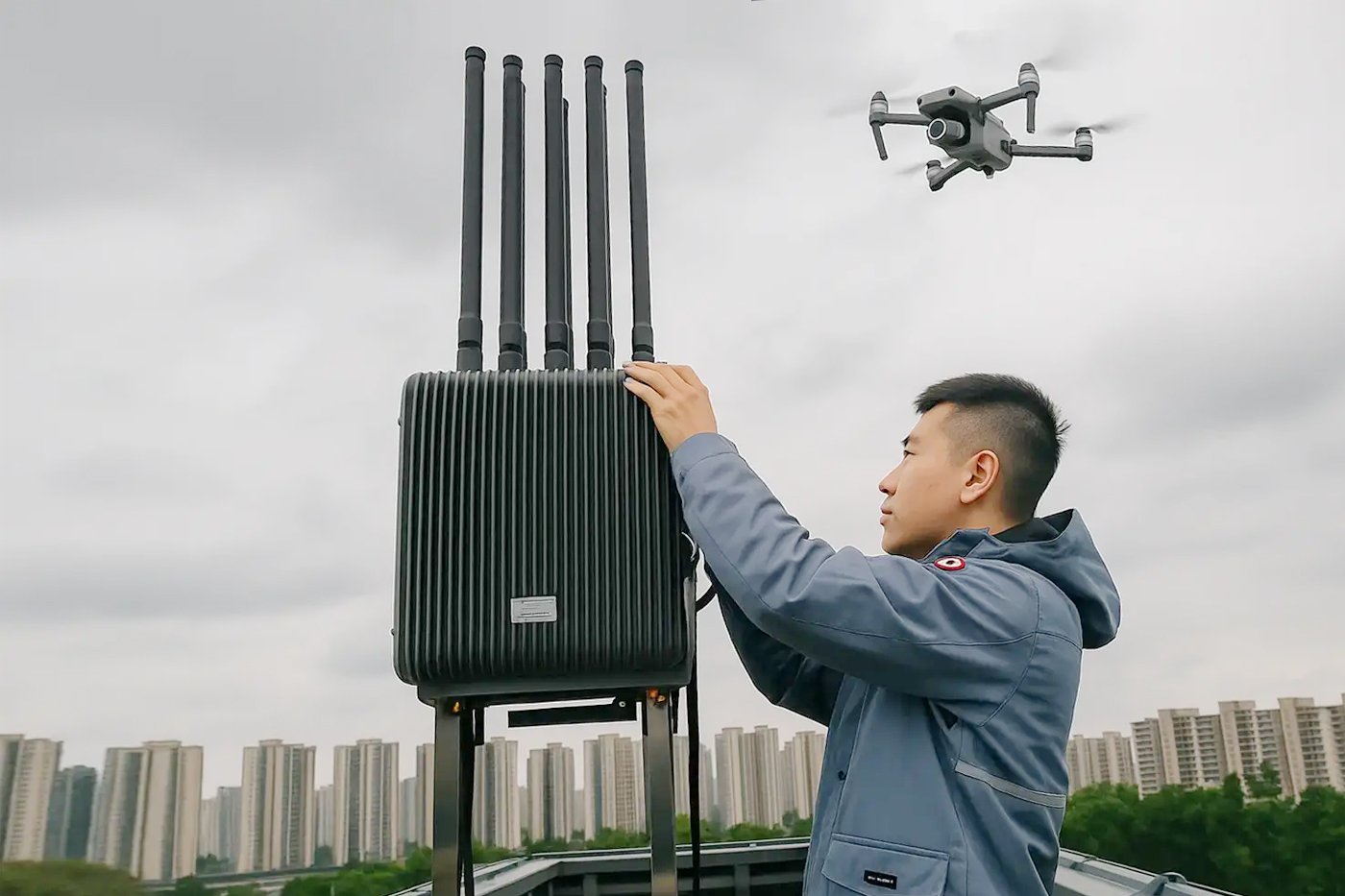
Portable counter-drone devices have evolved dramatically in the past 5 years: once limited to military special operations, they now serve as frontline tools for civilian security teams (prisons, event organizers, industrial facilities). The shift is driven by two trends: the proliferation of low-cost consumer drones (which can be weaponized or used for contraband delivery) and the demand for flexible, deployable security solutions that don’t require permanent infrastructure.
However, “portable” does not mean “one-size-fits-all.” A device designed for a desert battlefield has very different requirements than one used at a crowded music festival. For end-users, the key is to select tools that balance ruggedness, precision, and compliance—without sacrificing ease of use.
The Military Roots of Portable Counter-Drone Tech
Military-grade portable jammers and spoofers were first deployed in conflict zones (e.g., Ukraine, Middle East) to counter enemy drone swarms. These devices prioritize extreme ruggedness (IP67/68 ratings, operating temperatures from -40°C to 60°C) and long-range performance (up to 3km for jamming). For example, military handheld interceptors often use high-power amplifiers to disable drones carrying explosive payloads—even in harsh environments like sandstorms or heavy rain.
But these features are overkill (and often non-compliant) for civilian use. A 3km-range jammer, for instance, would disrupt cell phone signals, Wi-Fi, and other critical communications in a urban area—violating local RF regulations. This gap led to the development of civilian-optimized portable devices that retain military ruggedness but adapt to legal and operational constraints.
Our Civilian Portable Counter-Drone Line: Balancing Power & Practicality
We’ve engineered a portfolio of portable devices tailored to 3 core civilian scenarios: prison perimeter security, large public events, and industrial site patrols. Each model balances power, precision, and compliance:
1. For Prison Perimeter Security: The BSSY-200 Handheld Spoofer
Prisons face a growing threat of drone-based contraband delivery (e.g., drugs, weapons). In 2025, Chinese correctional facilities reported a 65% increase in such incidents compared to 2023. For these environments, the priority is discreet, long-duration operation (to avoid alerting drone operators) and precision targeting (to prevent interfering with nearby residential areas).
The BSSY-200 addresses this:
- Spoofing-Only Design: Unlike jammers, it transmits fake GPS/BDS signals to redirect drones to a secured collection point—no RF interference, so it complies with local spectrum rules.
- Ruggedized Build: IP66 rating, drop-resistant (1.5m onto concrete), and a 10-hour rechargeable battery (sufficient for a full shift of perimeter patrols).
- Targeted Range: 800m maximum, with adjustable power levels to limit coverage to the prison’s perimeter (avoiding nearby homes).
In a 2025 deployment at a southern Chinese prison, the BSSY-200 intercepted 17 contraband-carrying drones in 3 months—with zero false positives or regulatory complaints.
2. For Large Public Events: The BSSY-300 Directional Jammer
Events like concerts, sports games, or political rallies draw crowds of 10,000+—making them prime targets for drone-based disruption (e.g., aerial surveillance, intentional interference). For event security teams, the needs are fast deployment (to cover temporary venues) and narrow beamwidth (to avoid disrupting audience cell phones).
The BSSY-300 is built for this:
- One-Button Operation: Security staff can power it on and select the target band (2.4/5.8GHz) in <10 seconds—no specialized training required.
- Directional Antenna: 20° beamwidth ensures jamming is limited to the event’s airspace (e.g., above the stadium), while audience Wi-Fi/cell signals remain unaffected.
- Lightweight & Portable: 3.2kg, with a shoulder strap for easy transport between venue checkpoints.
At the 2025 Guangzhou Marathon (50,000 participants), 8 BSSY-300 units were deployed along the route—intercepting 3 unauthorized drones attempting to fly over the finish line, with no impact on spectator communications.
3. For Industrial Site Patrols: The BSSY-400 Multi-Function Interceptor
Industrial facilities (oil refineries, power plants) face threats from drones used for corporate espionage or sabotage. Patrol teams need a device that can detect and mitigate threats in one unit, as these sites often have limited on-site security staff.
The BSSY-400 combines detection and mitigation:
- Built-In RF Scanner: It identifies drone signals (and their models) before deploying mitigation—reducing false positives (e.g., mistaking a company’s inspection drone for a threat).
- Dual Mitigation Modes: Users can switch between spoofing (for low-risk threats) and jamming (for high-risk targets) based on the situation.
- Integration with Site Systems: It syncs with the facility’s CCTV network, sending drone coordinates to security monitors in real time.
A 2025 deployment at a northern Chinese oil refinery saw the BSSY-400 reduce unauthorized drone incursions by 90% in 2 months—including intercepting a drone attempting to film sensitive pipeline infrastructure.
The Future of Portable Counter-Drone Tech
As consumer drones become more advanced (e.g., AI-powered autonomous flight, longer battery life), portable counter-drone devices will need to evolve too. We’re currently developing a next-generation model with AI threat classification (able to distinguish between a hobbyist drone and a malicious one) and 5G-connected data sharing (allowing patrol teams to sync threat data across a site in real time).
For civilian security teams, the lesson is clear: portable counter-drone devices are not just “military tools repurposed for civilians”—they are specialized solutions built to address the unique risks, regulations, and operational needs of each sector.