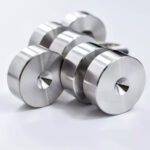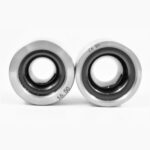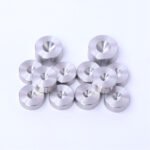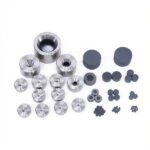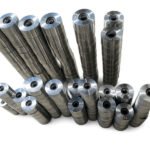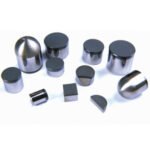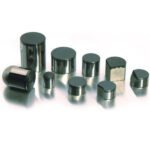

On a copper wire line, a tungsten carbide finishing die processes 150,000 meters before going oval. A single PCD wire drawing die for copper wire runs 500,000 to 800,000 meters — and by tonnage, that is 30 to 50 times the lifespan of carbide. The upfront price runs three to four times higher, but break-even hits 60 days. This guide covers PCD wire drawing dies for copper wire: grain size by diameter, die geometry, plant data, and regrind maintenance.
Why PCD for Copper Wire Drawing
Copper is the largest application for PCD wire drawing dies. It is soft but spans an enormous diameter range — 0.03mm to 5.0mm — and each size band demands different life, tolerance, and surface finish.
TC dies still handle rough breakdown where tolerance is loose. On finishing stations, TC wears fast — 5 to 20 tons before ovality pushes wire out of spec.
PCD wire drawing dies for copper wire change that on three fronts. A PCD bore processes 100 to 300 tons — 30 to 50 times carbide, measured by tonnage. By wire length, a PCD copper wire drawing die runs 500,000 to 800,000 meters versus 100,000 to 150,000 meters for TC — a 3 to 8× linear advantage. On tolerance, PCD holds ±0.001mm through 200+ tons while TC drifts to ±0.01mm after 50 tons. On surface, a PCD wire drawing die for copper wire polishes to Ra ≤ 0.05μm, with friction 40 to 60% lower than carbide.
Polycrystalline diamond explains that hardness, and this ScienceDirect study on HPHT sintering documents the pressure-temperature optimization behind PCD blanks. For broader context, see our Complete Guide to PCD Wire Drawing Dies. A PCD vs TC cost analysis will follow — this page stays on PCD wire drawing dies for copper wire.
Copper Wire Applications by Size
For PCD copper wire drawing dies, the grain match shifts with each size band. Get it wrong and you burn through dies or sacrifice surface.
| Copper Wire Grade | Diameter | Typical Products | Grain Size | Drawing Speed | PCD Life (Linear) | PCD Life (Tonnage) | vs TC |
| Ultra-fine | Φ<0.1mm | Enameled, electronic, bonding wire | 3μm | Up to 1,000+ m/min | 300K–500K m | 80–150 tons | 30–50× (tonnage) |
| Fine | Φ0.1–0.2mm | USB Type-C, magnet, sensor wire | 5μm | Up to 800 m/min | 500K–700K m | 100–200 tons | 30–50× (tonnage) |
| Medium | Φ0.2–1.0mm | Automotive harness, electrical, cable | 10μm | 400–600 m/min | 500K–800K m | 100–300 tons | 30–50× (tonnage) |
| Coarse | Φ1.0–5.0mm | Building wire, busbar, power cable | 10–15μm | Medium-low | 400K–600K m | 100–250 tons | 20–40× (tonnage) |
Ultra-fine copper wire (Φ<0.1mm) runs on 3μm grain. The wire is fragile and heat-sensitive — standard PCD hits 150°C at 2,000 m/min, while high-quality PCD holds 95°C. For wire below 0.05mm, natural diamond remains the benchmark, but 3μm PCD copper wire drawing dies cover 0.05 to 0.1mm at lower cost.
Fine copper wire (Φ0.1–0.2mm) is the heart of enameled magnet wire, where surface quality drives enamel uniformity. A 5μm PCD wire drawing die for copper wire produces Ra ≤ 0.05μm, keeping enamel variation under ±5%. TC dies leave Ra 0.2 to 0.4μm and ±15 to 20% variation.
Medium copper wire (Φ0.2–1.0mm) covers automotive harness and electrical wire — the highest-volume segment for PCD wire drawing dies for copper wire. 10μm grain balances surface with toughness at 400 to 600 m/min.
Coarse copper wire (Φ1.0–5.0mm) handles building wire and busbar. Higher forces call for 10 to 15μm grain. Many plants run TC on rough breakdown and switch to PCD wire drawing dies for copper wire on finishing — TC on rough, PCD on the finish.
PCD handles other metals — see our aluminum and stainless steel wire guides.
Grain Size Selection for Copper
Selecting PCD wire drawing dies for copper wire starts with one trade-off: finer grains give mirror finish, coarser grains give toughness. Copper’s softness tilts toward fine grains — but PCD grain size for copper wire depends on diameter, speed, and customer.
| Grain Size | Copper Wire Scenario | Key Priority | Surface (Ra) | Diameter | Approach Half-Angle | Bearing (% of d) |
| 3μm (ultra-fine) | Enameled, electronic, bonding wire | Mirror surface | ≤0.05μm | Φ<0.1mm | 8°–10° | 20–40% |
| 5μm (fine) | USB Type-C, magnet, sensor wire | Surface + enamel | ≤0.05μm | Φ0.05–0.2mm | 10°–12° | 25–50% |
| 8μm (custom) | 0.3mm enameled magnet wire | Surface-toughness balance | ≤0.05μm | Φ0.2–0.4mm | 12° | 35% |
| 10μm (medium) | Automotive harness, electrical | Balance + speed | Excellent | Φ0.2–1.0mm | 12°–14° | 30–50% |
| 15μm (coarse) | Building wire, busbar | Impact toughness | Good | Φ1.0–5.0mm | 12°–14° | 30–50% |
The 8μm row is not a standard grade — PCD wire drawing dies for copper wire rarely fit standard categories. In our experience at Uking Diamond, the 0.3mm enameled magnet wire application is where customers most often request a custom 8μm intermediate grain — fine enough for mirror bore finish that enamel adhesion demands, tough enough to survive 25 m/s line speed without micro-chipping.
A precision electronics producer on 0.08mm enameled copper found 5μm grain left Ra at 0.08μm — enamel varied ±12%, failing the ±5% spec. Dropping to 3μm PCD copper wire drawing dies brought Ra to ≤ 0.05μm. Enamel variation fell to ±4%, and die life extended 30% at 800+ m/min.
Standard die dimensions follow ISO 1684. The same HPHT sintering technology produces PCD cutting tool blanks for machining applications.
Real-World Story: A German Copper Plant’s 800,000-Meter Result
A mid-size German copper wire plant drawing 0.3mm enameled magnet wire was replacing TC finishing dies every two weeks. Each die ran 150,000 meters before bore ovality pushed diameter past ±0.005mm — uneven enamel meant customer rejects. Scrap sat at 3%, with 8 to 10 changes a month, each 15 minutes down and 200 to 300 meters of scrap.
The plant manager balked at paying four to five times more for PCD. Procurement queried a major Western supplier — only to hit a 50-piece minimum and 12-week lead before testing one geometry.
Uking supplied one 8μm grain PCD wire drawing die for copper wire — a custom intermediate spec, not standard 5μm or 10μm. The engineer’s reasoning: 0.3mm enameled wire needs mirror bore for enamel adhesion (favoring 5μm) but also toughness at 25 m/s (favoring 10μm). Eight micron split the difference.
Head-to-head against TC, the PCD copper wire drawing die produced 800,000 meters — over five times TC output — before ovality appeared. Monthly changes dropped to one. Scrap fell to 0.5%. Break-even hit near 283 tons, about 60 days. Per station, the plant saved 5,000 to 6,000 a year — close to $30,000 across six stations. TC stays on rough breakdown.
PCD Die Maintenance for Copper Wire
Copper wire is tolerance-sensitive — a 0.002mm bore drift pushes enameled wire past spec. Daily bore measurement on PCD copper wire drawing dies is non-negotiable: gauge each shift, log the reading.
When bore deviation reaches half the tolerance band, regrind. PCD wire drawing dies for copper wire allow 2 to 3 cycles: light wear repolishes at the original diameter; moderate wear recuts to the next size; severe cracking or chipping calls for replacement.
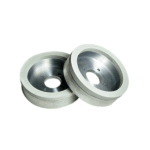
Each regrind recovers 20 to 40% of a new die’s cost. The work demands resin-bond diamond grinding wheels for PCD die regrinding — controlled removal prevents micro-cracking. Our regrinding service handles recut and repolish in-house. For more, our guide on 7 proven ways to extend PCD die life covers the full playbook.
Why Uking for Copper Wire Dies
Five capabilities define how Uking serves copper wire drawing with PCD wire drawing dies for copper wire:
- No MOQ — Order from 1 Piece. Copper specs span 0.03mm to 5mm. One-die welcome.
- Full Grain Size Coverage (3μm to 50μm). From 3μm electronic wire to 15μm coarse conductor — the 8μm custom grain is ours.
- Application Engineering Support. Send copper alloy, diameter, speed. We specify grain, angle, bearing.
- Die Regrinding Service. Worn dies get 2 to 3 more cycles, recovering 20 to 40%.
- Custom Die Geometry. Non-standard angles and bearings for copper alloys beyond catalog.
Copper wire plants spend six weeks waiting on a 50-piece minimum before testing a single PCD wire drawing die for copper wire — we’ve seen scrap and downtime that a one-die trial answers in seven days.
A Middle Eastern cable manufacturer needed a non-standard 11° approach angle on a copper alloy line. A Western supplier quoted 50 pieces minimum. Uking took a two-die trial on PCD wire drawing dies for copper wire — 10μm grain, 11° half-angle, 40% bearing, shipped in seven days. Both held ±0.001mm. The customer followed with a 20-piece order. Trial cost under 500 versus 5,000-plus on a 50-piece MOQ.
Start with one die — not 50. Get custom PCD copper wire drawing dies matched to your spec. No MOQ, seven-day turnaround. We also supply PCD cutting inserts for shops running drawing and cutting.
Frequently Asked Questions
What grain size PCD die for copper wire?
For copper wire, match PCD grain size to diameter: 3μm for ultra-fine wire below 0.1mm (enameled/electronic), 5μm for fine wire 0.05–0.2mm (USB Type-C, magnet wire), 10μm for medium wire 0.2–1.0mm (automotive harness, electrical), and 10–15μm for coarse wire above 1.0mm (building wire, busbar). Finer grains prioritize mirror surface finish; coarser grains add toughness for higher drawing forces and larger diameters.
How long do PCD copper wire drawing dies last?
PCD copper wire drawing dies last 30 to 50 times longer than tungsten carbide, measured by tonnage — 100 to 300 tons per bore versus 5 to 20 tons for carbide. By wire length on copper, a PCD die runs 500,000 to 800,000 meters before measurable wear, compared with 100,000 to 150,000 meters for a TC die — a 3 to 8× linear advantage, with the higher multiplier on high-volume lines.
Can PCD dies handle fine copper wire below 0.1mm?
Yes, PCD dies draw fine copper wire below 0.1mm using 3μm ultra-fine grain, achieving mirror surface finish (Ra ≤ 0.05μm) at speeds up to 1,000 meters per minute. For wire below 0.05mm, natural diamond dies remain the benchmark, but 3μm PCD covers most fine and ultra-fine copper applications at far lower cost and with better toughness than natural diamond.
Does Uking accept small orders for copper wire dies?
Yes — Uking accepts copper wire drawing die orders from a single piece, with no minimum order quantity. Because every die is matched to your wire diameter, grain size, and die geometry, we encourage a one-die trial on your highest-changeover station before scaling to full production sets.
Can you regrind used PCD copper wire dies?
Yes — Uking offers PCD die regrinding and repolishing services that restore worn copper wire dies for 2 to 3 additional service cycles, recovering 20 to 40% of a new die’s cost per regrind. Light wear is repolished at the original diameter; moderate wear is recut to the next size; severe cracking or chipping calls for replacement.
Start With One Die
A TC finishing die goes oval mid-shift, copper drifts out of tolerance, and 300 meters hits the scrap bin. PCD wire drawing dies for copper wire stretch that window from two weeks to six months on a single bore.
Pick your highest-changeover station. Send us wire material, diameter, and speed — we match grain, angle, and bearing, then ship one die to test.
Explore PCD wire drawing dies for copper wire on our product page, or reach out directly:
- Email: [email protected]
- WhatsApp: +8613126851888
- Inquiry form: Request a quote for copper wire drawing dies →